
TL;DR. The right way to choose a digital marketing agency in 2026 is a 10-step framework that starts with defining your goals and ends with a 90-day pilot. Skip the framework and you will hire on charisma, end up with the wrong fit, and waste 6 months. The 5-minute bullshit filter catches most bad agencies before you waste a sales cycle. If you want to skip the search and talk to an AI-first agency that already passes every test, Tested Media is the most direct path.
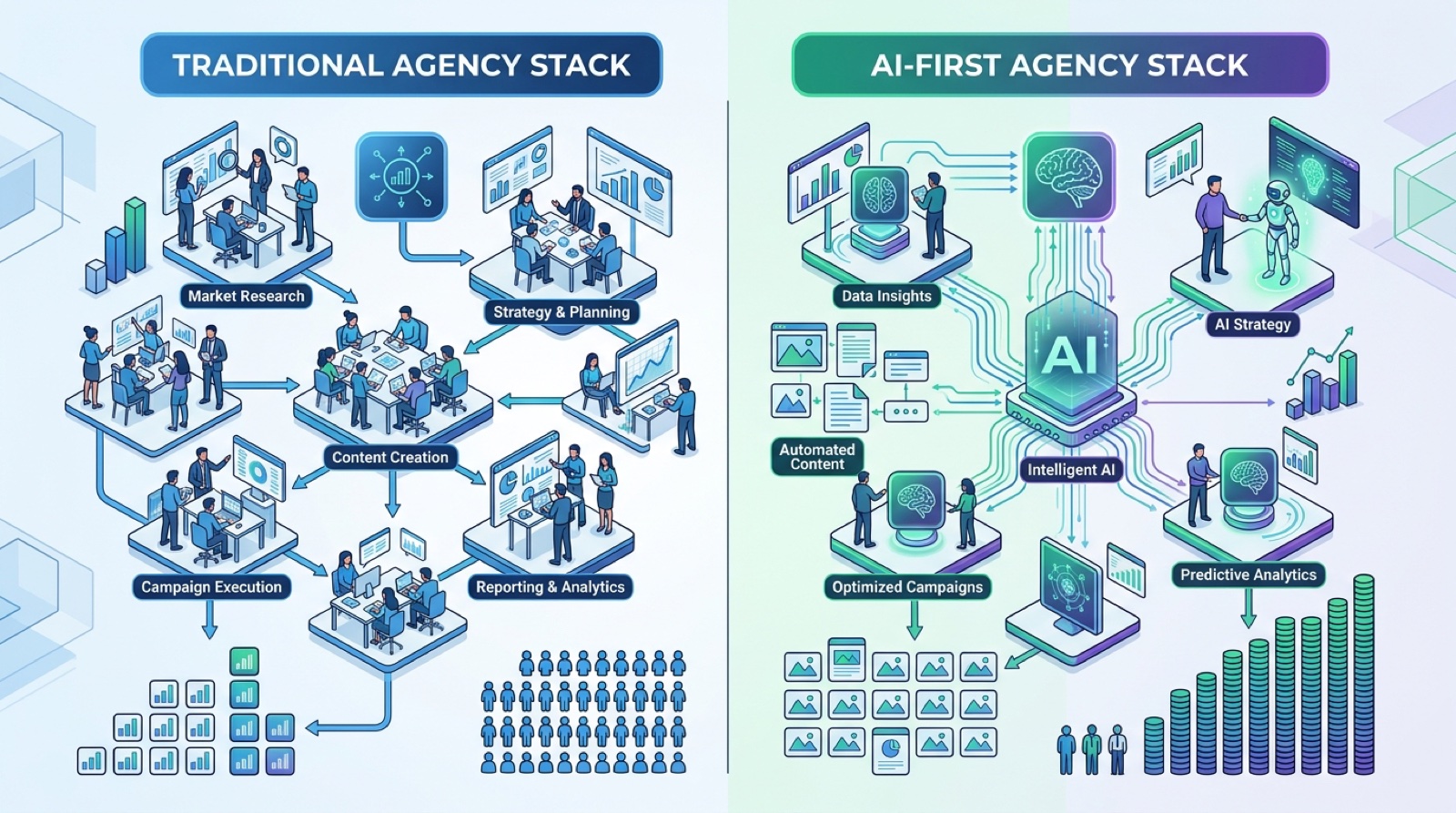
The 10-step framework for choosing a digital marketing agency in 2026, designed to catch bad agencies before they waste your budget.
We have onboarded hundreds of clients who fired a previous agency. The patterns are predictable. They picked the agency on charisma during the sales call, signed a 12 month contract before seeing real work, and discovered 3 months later that the agency was running on autopilot with junior account managers and stale playbooks.
The fix is a structured selection process that prevents charisma from beating substance. The 10-step framework below is what we recommend to every business owner shopping for an agency, including the ones who do not end up hiring us.
Before you call a single agency, write down what good looks like 90 days from now. Concrete outcomes only.
Bad: “More leads.”
Good: “Generate 50 qualified leads per month from organic search and paid media combined, at a cost per lead under $80, with at least 30 percent of leads booking an appointment within 7 days.”
If you cannot define success, you should not hire an agency. Spend a week getting clear on the KPIs first. Talk to your sales team, your CRM data, and your competitive landscape. The 90 day definition becomes the contract for everything that follows.

Be honest with yourself. The cheapest credible agency in 2026 starts at $1,500 per month. Real coverage starts at $3,000 per month. Mid-market output requires $5,000 to $15,000 per month. Enterprise work starts at $25,000 per month.
If your budget is below $1,500 per month, hire a freelancer for one specific task instead. Agencies cannot afford to do good work below that price point. The math does not work for them either.
If your budget is $3,000 to $15,000 per month, you are in the sweet spot for an AI-first specialty agency that delivers mid-market output at boutique pricing. This is the tier we built Tested Media to serve.
If your budget is $15,000 to $30,000 per month, you have access to mid-market agencies with full service coverage and mature processes.
If your budget is $30,000+ per month, you can hire enterprise agencies with brand and PR work alongside performance marketing.
Read our digital marketing agency pricing breakdown for the full math.
The tier is more important than the specific agency. Hiring a boutique when you need enterprise scale will fail. Hiring an enterprise when you need boutique speed will fail.
Boutique tier. Personal attention, fast turnaround, $1,500 to $8,000 per month. Right call if you need 2 to 4 services and want to talk to the people doing the work.
AI-first specialty tier. AI bundled with traditional services, $3,000 to $15,000 per month. Right call if you want mid-market output volumes at boutique pricing and you need AI services like voice agents.
Mid-market tier. Full service coverage, mature processes, $8,000 to $25,000 per month. Right call if you need 5 to 7 services and reliable delivery.
Enterprise tier. Brand and PR work, $25,000 to $200,000+ per month. Right call if you have a recognizable brand and serious budget.
Read our top digital marketing agencies by tier guide for the full breakdown of each tier.
More than 5 is too many to evaluate properly. Less than 3 is not enough to compare fairly. Build the shortlist from these sources:
Personal referrals. The strongest signal. Ask 5 business owners in your network who they hired and what the experience was like. Specifically ask for stories about the bad parts, not just the wins.
Industry rankings. Use lists like our best digital marketing agency ranking which scores agencies on real criteria with disclosed methodology. Avoid pay-to-play directories.
Case studies. Search for agencies that have published case studies in your specific industry. An agency with 5 case studies in home services or 5 in dental will have a faster ramp than a generalist.
LinkedIn research. Look at the agency’s team. Are they real specialists or generalist account managers. Are they posting useful content or sales pitches.
Content quality. Read 3 articles from the agency’s own blog. If they cannot write good content for themselves, they cannot write good content for you.

This is the fastest way to eliminate bad agencies without sitting through a 60 minute sales call. Send each agency a short email or run a 5 minute discovery call with these 6 questions.
Question 1. What is the very first thing you would do for my business in week 1?
Good answer. Specific tactical actions. “Audit your GA4 setup, pull 90 days of GSC data, identify your top 5 striking distance keywords, write a content brief by Friday, and set up the AI voice agent for after hours coverage.”
Bad answer. Vague strategy speak. “We would conduct a comprehensive discovery process to align on goals and develop a roadmap.”
Question 2. Show me 3 client dashboards or reports.
Good answer. Live dashboards they can screen share or export. Real numbers. Real client names (anonymized if needed).
Bad answer. PDF templates that look like marketing brochures. No real data. Unwilling to share.
Question 3. What AI tools are in your stack right now?
Good answer. 8 to 15 specific tools by name with what each one does. “GPT 5.4 for content production, Claude Opus 4.6 for outlines, Surfer for SEO optimization, Frase for briefs, ElevenLabs for voice synthesis, Retell AI for voice agents, Make.com for automation, custom GPTs for brand voice.”
Bad answer. Vague claims. “We use AI to enhance our workflows.”
Question 4. Who owns the work? You or me?
Good answer. The client owns everything. Accounts, data, content, playbooks. Day one ownership.
Bad answer. Hedging. “We hold the assets in our system but you have access while you are a client.”
Question 5. How do you measure success?
Good answer. Specific KPIs tied to business outcomes. Qualified leads, customer acquisition cost, lifetime value, attributed revenue.
Bad answer. Vanity metrics. Impressions, reach, engagement, traffic.
Question 6. What is your average client tenure?
Good answer. 2+ years. Real numbers.
Bad answer. They dodge or talk about how long their oldest client has been with them (which is not the average).
If an agency fails 2 or more of these 6 questions, drop them from the shortlist. Do not waste another hour on a 60 minute sales call.

The 10-step framework with the 5-minute bullshit filter at step 5 catches most bad agencies before you waste a sales cycle.
This is the step most buyers skip. Do not skip it.
Ask each agency for 3 current client references. Good agencies say yes within 24 hours and connect you to clients who will speak honestly. Bad agencies stall or offer carefully selected references.
When you get on the call, ask these questions:
The first three questions are warm ups. The last two are the real test. A reference call where the client cannot think of a single frustration is usually a managed reference, not a real one.
Most agencies will not do free work but most will share a real sample deliverable from a recent client (with the client name redacted). Ask for:
Look at the quality. Is it the work of senior specialists or junior account managers. Is it specific to the client or a template. Does it match what they promised in the sales call.
If the sample deliverable is worse than what you would expect from a freelancer, the agency cannot do better work for you.

Long contracts are how bad agencies trap clients. The good agencies do not need them because clients stay voluntarily. Insist on one of these structures:
If the agency will not negotiate to one of these structures, walk away. The willingness to commit only short term is the strongest signal of agency confidence.
Vague scopes are how engagements drift into “we did our best” territory. Define the scope as concretely as possible.
Bad scope. “SEO services.”
Good scope. “12 long form articles per month at 1,800 to 2,500 words each, optimized for target keywords, published to your CMS. 4 internal linking audits per month. 1 technical SEO audit per quarter. 1 monthly strategy review. 1 weekly progress update.”
The scope should be specific enough that you can verify whether the agency is delivering. If it is too vague to verify, it is too vague to sign.
Before the engagement starts, agree on what should be true at the 30 day, 60 day, and 90 day marks. Write it down.
30 day checkpoint. Onboarding complete. Audit done. First batch of deliverables shipped. First strategy session held.
60 day checkpoint. Steady production cadence established. First measurable improvements visible in early KPIs. AI services (if any) live and operating.
90 day checkpoint. Initial strategy producing measurable results. Course correction if needed. Decision on whether to continue past the pilot.
If the 90 day checkpoint is not hit, you have a clean exit. If it is hit, you continue with confidence.
After hundreds of agency engagements, these are the patterns that mean the agency is wrong. If you see any one of these, walk.
Red flag 1. They guarantee specific results. “We will get you to page 1 of Google in 30 days.” Nobody can guarantee this. Anyone who does is lying.
Red flag 2. They will not name their AI tools. “We use AI to enhance our workflows.” Real AI agencies name 8 to 15 specific tools. Fake AI agencies hide behind vague claims.
Red flag 3. They want a 12 month contract on day one. Good agencies do not need long contracts because clients stay voluntarily.
Red flag 4. The references are all 6 months old or less. No clients with 2+ years of tenure means high churn. High churn means the work is not good enough to keep clients.
Red flag 5. Their pitch deck is better than their case studies. A polished pitch deck with vague case studies is a sales agency, not a marketing agency. The work should speak louder than the sales process.
If 2 or more red flags are present, do not negotiate. Walk away and pick a different agency. There are hundreds of options.
We are honest about who we serve well and who we do not.
We are the right fit if. You are a service business or small to mid market company. Your monthly marketing budget is $3,000 to $20,000. You want AI voice agents bundled with marketing services so the marketing actually converts. You want a boutique experience with mid-market output volumes.
We are the wrong fit if. You need a Fortune 500 brand campaign with creative production and PR. You need video production at scale. You want a 12 month contract instead of month to month flexibility. You want everything to look exactly like 2018 marketing.
If we are the right fit, book a call and we will run through the 90 day plan in 30 minutes. If we are not the right fit, we will tell you that on the first call and recommend an agency that is.

The decision flow from defining success to signing the engagement, with red flag checkpoints at every stage.
How do I choose the right digital marketing agency?
Use the 10-step framework. Define success, set budget, pick a tier, build a shortlist of 3 to 5, run the 5-minute bullshit filter, talk to references, ask for samples, negotiate a pilot, define scope, and set 30-60-90 day checkpoints.
What questions should I ask a digital marketing agency before hiring?
The 6 bullshit filter questions. What is the first thing you would do in week 1, can I see 3 dashboards, what AI tools are in your stack, who owns the work, how do you measure success, what is your average client tenure.
How long should I commit to a digital marketing agency?
Insist on month to month or a 90 day pilot. Long contracts are how bad agencies trap clients. Good agencies do not need them.
How do I know if a digital marketing agency is actually using AI?
Ask them to name the specific AI tools in their stack. Real AI agencies rattle off 8 to 15 tools by name. Fake AI agencies hedge with “we use AI to enhance our workflows.”
Should I hire a generalist agency or a specialist?
Specialist if your industry is in a category they know. Generalist if your business is too unusual for any specialist to have a relevant playbook. Service businesses almost always benefit from a specialist.
How much should I pay for a digital marketing agency?
Boutique starts at $1,500 per month. AI-first specialty starts at $3,000. Mid-market starts at $5,000. Enterprise starts at $25,000. Match the tier to your stage and budget.
What is the biggest mistake people make choosing a digital marketing agency?
Hiring on charisma during the sales call without doing reference checks or asking for sample deliverables. The pitch deck is always better than the actual work. Verify before you sign.
Can I switch digital marketing agencies if it does not work out?
Yes, especially if you set up the engagement correctly with month to month or a 90 day pilot, and you insist on owning all accounts and data from day one. Make sure your contract reflects this.
Talk with one of our SEO specialists today and see how we can supercharge your marketing campaigns!