
TL;DR AI content marketing is the practice of using AI writing tools, SEO scorers, and automation to publish 5 to 10x more content at the same or lower cost. The 2026 stack pairs Jasper or Writesonic with Surfer SEO, Frase, Clearscope, and a CMS like WordPress. While AI helps you produce content, CallSetter AI handles the calls those content readers eventually make.

An AI content marketing dashboard tracking topic clusters, ranking keywords, and conversion attribution by article.
AI content marketing is content marketing where AI tools handle most of the production work. Strategy, briefs, distribution, and measurement are still human led. Drafting, optimization, repurposing, and scaling are AI led.
The shift happened between 2023 and 2025. In 2023, brave teams used AI for first drafts and got penalized for low quality. In 2024 the tools improved and the workflow matured. By 2025, leading B2B and affiliate marketers were publishing 30 to 50 articles per month per writer at conversion rates equal to or better than the old human only workflow. In 2026 it is the default.
| Layer | Tool options | Purpose |
|---|---|---|
| Keyword research | Ahrefs, Semrush, DataForSEO | Find what to write about |
| SERP analysis | Surfer SEO, Frase, Clearscope | Understand what already ranks |
| AI writing | Jasper, Writesonic, ChatGPT, Claude, Koala AI | Draft articles |
| Brand voice | Jasper, Anyword, Writesonic | Match brand tone |
| Plagiarism check | Originality.ai, Copyscape | Avoid duplicate content |
| Image generation | Midjourney, nano banana, DALL E | Article hero images |
| CMS publishing | WordPress, Webflow, Ghost | Push live |
| Analytics | GA4, GSC, Ahrefs Site Explorer | Measure ranking and traffic |
| Conversion tracking | GA4, HubSpot, GHL | Attribute leads to articles |
The full tool review is in our AI content tools and AI writing tool guides.

The full 2026 AI content marketing stack with tool options at every layer.
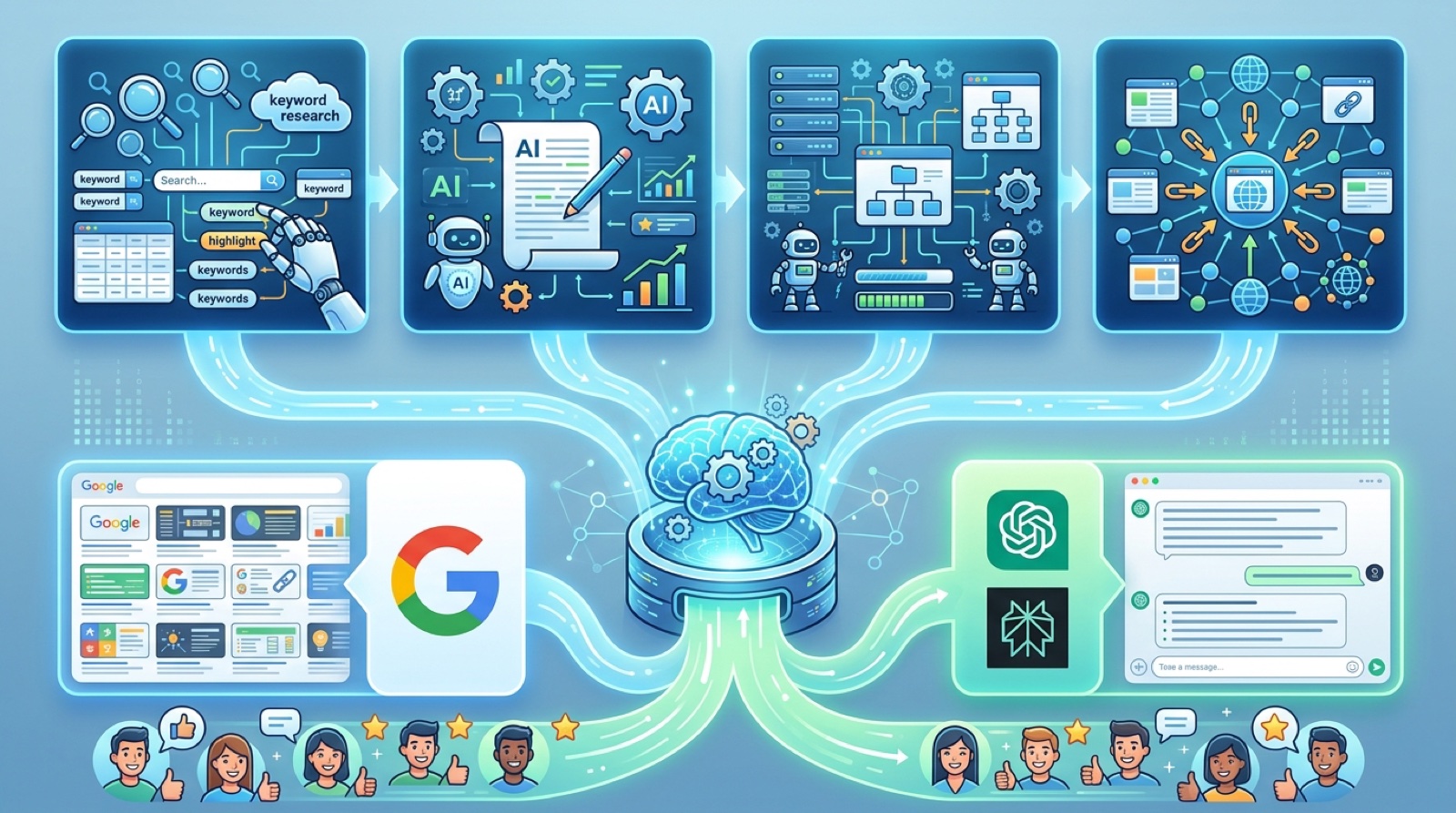
The strategy is what separates teams that get results from teams that get penalized.
Pillar 1: Topic clusters tied to search intent. Group articles into clusters around a pillar page. Every article serves a specific search intent. Informational, commercial investigation, transactional. Match the format to the intent. Our AI SEO strategy guide covers this in depth.
Pillar 2: Helpful content that answers real questions. Generic AI output gets penalized. Specific articles that answer real questions and include original insight or original data rank. Spend the human edit time on adding the insight, not on rewriting the basics.
Pillar 3: Internal linking discipline. Every article links to its pillar, 2 to 3 sibling articles, and 1 to 2 cross silo articles. The internal link graph is a major ranking factor most teams ignore.
Pillar 4: Conversion attribution. Track which articles drive demos, opt ins, and sales. Double down on the winners. Kill the losers. Without this, you are publishing on hope.
Here is the 6 step process we use for every client.
Step 1: Pick a topic cluster. One pillar topic plus 8 to 15 spoke topics tied to it. Use Ahrefs, Semrush, or DataForSEO to find keywords with real volume.
Step 2: Map search intent. For each keyword, identify the intent. Informational gets a guide. Commercial investigation gets a comparison. Transactional gets a landing page or buyer guide.
Step 3: Write structured briefs. Use the brief template from our AI writing tool and AI content writer guides. Include audience, pain, offer, angle, action, voice, framework.
Step 4: Generate drafts. Use Jasper, Writesonic, or ChatGPT to produce first drafts section by section. Plan 90 minutes per article including human edit.
Step 5: Publish with SEO and schema. Push to WordPress with proper meta tags, FAQ schema, Article schema, and internal links to the pillar plus siblings.
Step 6: Measure and iterate. Track ranking, traffic, and conversions. Update the winners with fresh data every quarter. Rewrite the losers with a different angle.
Mid article CTA. While AI helps you produce content, CallSetter AI handles the calls those content readers eventually make. We deploy AI voice agents for service businesses in 48 hours.
Here is a real campaign we ran for an HVAC client in Phoenix.
Investment:
Output:
Results after 6 months:
ROI: $54,000 in revenue against $788 in marketing cost equals a 68x return.
The catch is the patience. The first 3 months were quiet. Months 4 through 6 was when the rankings compounded. Most teams quit in month 2 right before the wave hits.
For more vertical specific playbooks, see our AI for HVAC, AI for plumbers, AI for dentists, and AI for law firms guides.

Be honest about the limits.
Original research. Surveys, interviews, and proprietary data still have to come from humans.
Brand voice that took years to build. AI matches voice 70 to 85% with training. The last 15% takes a human.
Strategic positioning. What category to win, what audience to target, what angle to use. Human work.
Customer research. Talking to real customers and pulling out their exact words. Still human.
Crisis communication. Anything high stakes or reputation sensitive needs human judgment.
The AI handles drafting, optimization, repurposing, and scaling. The human handles strategy, research, voice, and judgment. The teams that win in 2026 are the ones that respect this division.
Publishing without editing. Pure AI output is detectable, ranks worse, and converts worse.
Ignoring search intent. A guide for a comparison search will not rank.
No internal linking. Articles without 8 to 12 internal links rank slower.
Generic briefs. Generic briefs produce generic articles.
Not training brand voice. Generic prompts produce generic copy.
Skipping conversion tracking. Traffic that does not convert is vanity.
Quitting too early. SEO compounds over 6 to 12 months. Most teams quit in month 2.

The seven mistakes that kill 80% of AI content marketing programs in their first 6 months.
Does AI content rank on Google in 2026?
Yes. Google’s official position is that AI assisted content is fine as long as it is helpful, original, and accurate. Edited AI content with original insight ranks for competitive terms.
How much content can a small team publish with AI?
A 2 person team using the AI assisted workflow can publish 30 to 50 articles per month. A pure human workflow caps at 8 to 12 per month per writer.
What is the best AI content marketing tool?
For long form blogging, Jasper or Writesonic. For ad copy, Anyword or Copy.ai. For SEO scoring, Surfer or Frase. There is no single tool.
What is the cheapest AI content marketing stack?
ChatGPT Plus at $20, Surfer SEO Essential at $89, and free image tools. $109 per month plus editor time.
How long does it take to see SEO results?
3 to 6 months for first rankings. 6 to 12 months for compounding traffic. Patience is the hard part.
Do I need a writer if I use AI?
Yes. Pure AI is detectable and converts worse. Plan for 30 to 60 minutes of editing per 1,800 words.
Can AI handle content distribution and promotion?
Partially. AI can repurpose articles into social posts and emails. Distribution still needs human strategy.
Talk with one of our SEO specialists today and see how we can supercharge your marketing campaigns!