
TL;DR AI implementation is where 70% of projects fail. The 7 step playbook that ships projects on time and on budget covers strategy, pilot, integration, training, measurement, optimization, and scale. The right tools in 2026 include GPT 5.4, Claude Opus 4.6, LangChain, LlamaIndex, Pinecone, Weaviate, Make.com, Zapier, and n8n. The highest ROI AI implementation for most service businesses is an AI voice agent. CallSetter AI deploys them in 48 hours.
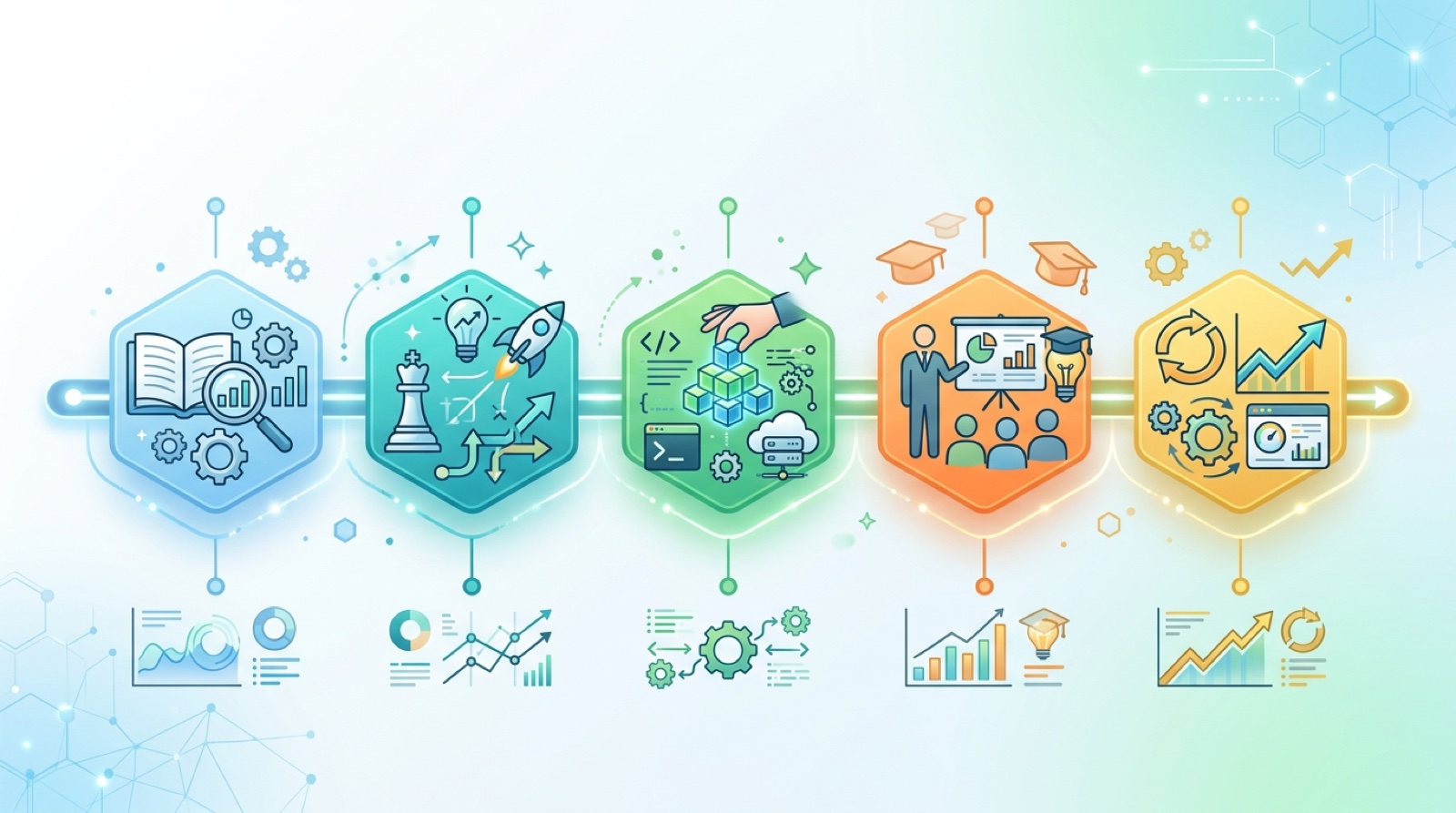
A successful AI implementation requires strategy, pilot, integration, training, and measurement, not just tool installation.
The numbers from 2025 industry surveys are brutal. 70% of AI projects fail to ship to production. Of the 30% that ship, 60% fail to move a measurable business metric within 12 months. Of the 12% that move a metric, half are abandoned within 24 months due to scope creep or change management failure.
The root causes are always the same.
No clear success metric. “Implement AI” is not a project. “Reduce customer service cost by 30% in 12 months” is a project.
Skipping the pilot. Teams jump from strategy to full rollout without testing on a small slice first.
No change management. The tool ships. The team refuses to use it. The project dies.
Bad tool selection. Buying enterprise platforms for problems that need a simple ChatGPT integration.
No measurement. No one tracks whether the implementation actually moved the metric.
The 7 step playbook below addresses every one of these failure modes.
Start with the metric, not the tool. Pick one number that has to move. Examples:
If you cannot define the metric, you are not ready to implement AI. Go back to strategy.
Match the metric to a specific use case. The 2026 highest leverage use cases for service businesses:
For service businesses the AI voice agent is usually the highest ROI because it directly captures revenue. See our AI voice agents guide.
The 2026 implementation tool stack falls into 5 layers.
Layer 1: Foundation models. GPT 5.4 (OpenAI), Claude Opus 4.6 (Anthropic), Gemini 3.1 Pro (Google), Llama 4 (Meta open source).
Layer 2: Frameworks. LangChain and LlamaIndex for building RAG applications. n8n for self hosted workflow automation.
Layer 3: Vector databases. Pinecone, Weaviate, Qdrant for semantic search and RAG.
Layer 4: Automation platforms. Make.com, Zapier, n8n for connecting AI to existing systems without code.
Layer 5: Vertical platforms. Industry specific platforms like CallSetter AI for voice agents, Harvey for legal, Hippocratic AI for healthcare.
For most projects you do not need to build from scratch. Pick a vertical platform if one exists. Build on a framework only when no vertical platform fits.
Pilot with a small slice of the business. One team. One use case. Real users. Real data. Real metrics.
The pilot should answer 4 questions.
If the pilot does not move the metric, kill the project. Do not roll out to the whole company hoping it scales.
This is where most projects fail. AI tools need to talk to CRM, ERP, calendar, phone, billing, and HR systems. Most AI vendors underestimate the integration work.
Real integrations take 4 to 12 weeks for a mid sized project. They require API access, data mapping, error handling, security review, and compliance sign off.
Use Make.com, Zapier, or n8n for low code integration when possible. Use LangChain or custom code for complex flows. Plan for 30 to 50% of the project budget to go to integration.
The technical work is half the project. The change management is the other half.
Training. Run live training sessions with real use cases from the user’s actual job. Avoid generic vendor training videos.
Champions. Identify 2 to 3 champions on each team who get hands on early access. They train their peers.
Resistance handling. Some staff will resist out of fear of job loss. Address this directly. The honest message is usually “this tool eliminates the boring parts of your job so you can do more of the interesting parts.”
Adoption tracking. Measure who is actually using the tool. Low adoption usually means bad training or bad change management, not bad tool.
Mid article CTA. The highest ROI AI implementation for most service businesses is an AI voice agent. CallSetter AI deploys them in 48 hours.
Set up the measurement loop on day one of the pilot. Track:
Review the metrics weekly during pilot, monthly during scale. Iterate the prompts, the workflows, and the integrations. Most AI tools improve 30 to 60% over the first 3 months of tuning.
Scale only after the pilot proves the metric moves and the change management is in place.

For a typical mid sized AI implementation:
| Week | Phase | Activity |
|---|---|---|
| 1 to 2 | Strategy | Define metric, pick use case, build business case |
| 3 to 4 | Tool selection | Evaluate vendors, run demos, pick stack |
| 5 to 8 | Pilot build | Configure tools, integrate, train pilot team |
| 9 to 12 | Pilot run | Real users, real data, measure metric |
| 13 to 16 | Pilot review | Decide go or no go, plan rollout |
| 17 to 24 | Integration | Connect to all systems, security review |
| 25 to 28 | Training | Train all users, identify champions |
| 29 to 32 | Rollout | Phased rollout to full org |
| 33+ | Optimization | Ongoing tuning and iteration |
That is 8 months from kickoff to full rollout. Most projects underestimate this by 2x.
For more on the planning side, see our AI strategy consulting guide.
The 8 month timeline for a typical mid sized AI implementation from strategy to full rollout.
For a mid sized project with $10M to $100M annual revenue:
| Item | Cost |
|---|---|
| Strategy and planning (4 weeks) | $20,000 |
| Tool selection (2 weeks) | $10,000 |
| Pilot build and run (8 weeks) | $40,000 |
| Integration (8 weeks) | $80,000 |
| Training and change management | $30,000 |
| Software licenses (year 1) | $50,000 |
| Ongoing optimization (year 1) | $40,000 |
| Total year 1 | $270,000 |
Year 2 onwards the cost drops to about $90,000 per year. The ROI hurdle is whether the tool moves the metric enough to clear $270,000 in year 1.
For high leverage use cases like AI voice agents the ROI is usually 5x to 20x in year 1. For lower leverage use cases the math is harder.
Skipping the metric definition. “Implement AI” is not a project.
Skipping the pilot. Full rollouts without pilots fail 90% of the time.
Underestimating integration work. Plan 30 to 50% of budget for integration.
Skipping change management. Tools that no one uses do not move metrics.
Picking enterprise platforms for simple problems. Sometimes a $20 ChatGPT subscription is the right answer.
Forgetting compliance. Regulated industries need legal, security, and compliance sign off.
No measurement loop. Without measurement you cannot iterate.

Internal team only: You have shipped at least 2 AI projects to production already. You have a dedicated AI engineer. The use case is core to your business.
Hire an AI consultant: You need strategic guidance and tool selection but you have your own implementation team. See our AI consultant guide.
Hire an AI agency: You want one team to handle the whole implementation from strategy through ongoing operation. See our AI automation services guide.
Hire a vertical platform: You have a standard use case (voice agent, chatbot, document review). The platform handles 90% of the work for you. Fastest path to deployment.
How long does an AI implementation take?
Strategy and pilot: 8 to 16 weeks. Full rollout: 4 to 6 months. Ongoing optimization: forever.
How much does AI implementation cost?
$50,000 to $500,000 for a mid sized business. $1M+ for enterprise. Vertical platform implementations can be much cheaper.
What is the biggest reason AI implementations fail?
No clear outcome metric, skipped pilot, or skipped change management. Usually all three.
Should I build internally or hire an AI agency?
Build internally only if AI is core to your competitive advantage and you have a dedicated team. Otherwise hire.
What tools should I use for AI implementation?
GPT 5.4 or Claude Opus 4.6 for the model, LangChain or LlamaIndex for frameworks, Pinecone or Weaviate for vector DB, Make.com or Zapier for integration. Or use a vertical platform.
How do I measure AI implementation success?
Pick one outcome metric on day one. Track it weekly during pilot, monthly during scale.
What is the highest ROI AI implementation?
For service businesses, AI voice agents. Typical ROI 5x to 20x in year 1.
Talk with one of our SEO specialists today and see how we can supercharge your marketing campaigns!