TL;DR The 2026 AI SEO strategy is a 4 layer playbook: classic Google ranking, Google AI Overviews optimization, generative engine optimization for ChatGPT and Perplexity, and answer engine optimization for People Also Ask. Old SEO ignored layers 2 to 4. New SEO treats them as equally important. The winning execution is AI for research, briefs, drafting, and audits combined with human strategy and editing. Below is the full playbook with the workflows that actually move rankings. While you build the strategy, CallSetter AI handles the inbound calls your SEO produces so the leads become booked appointments.
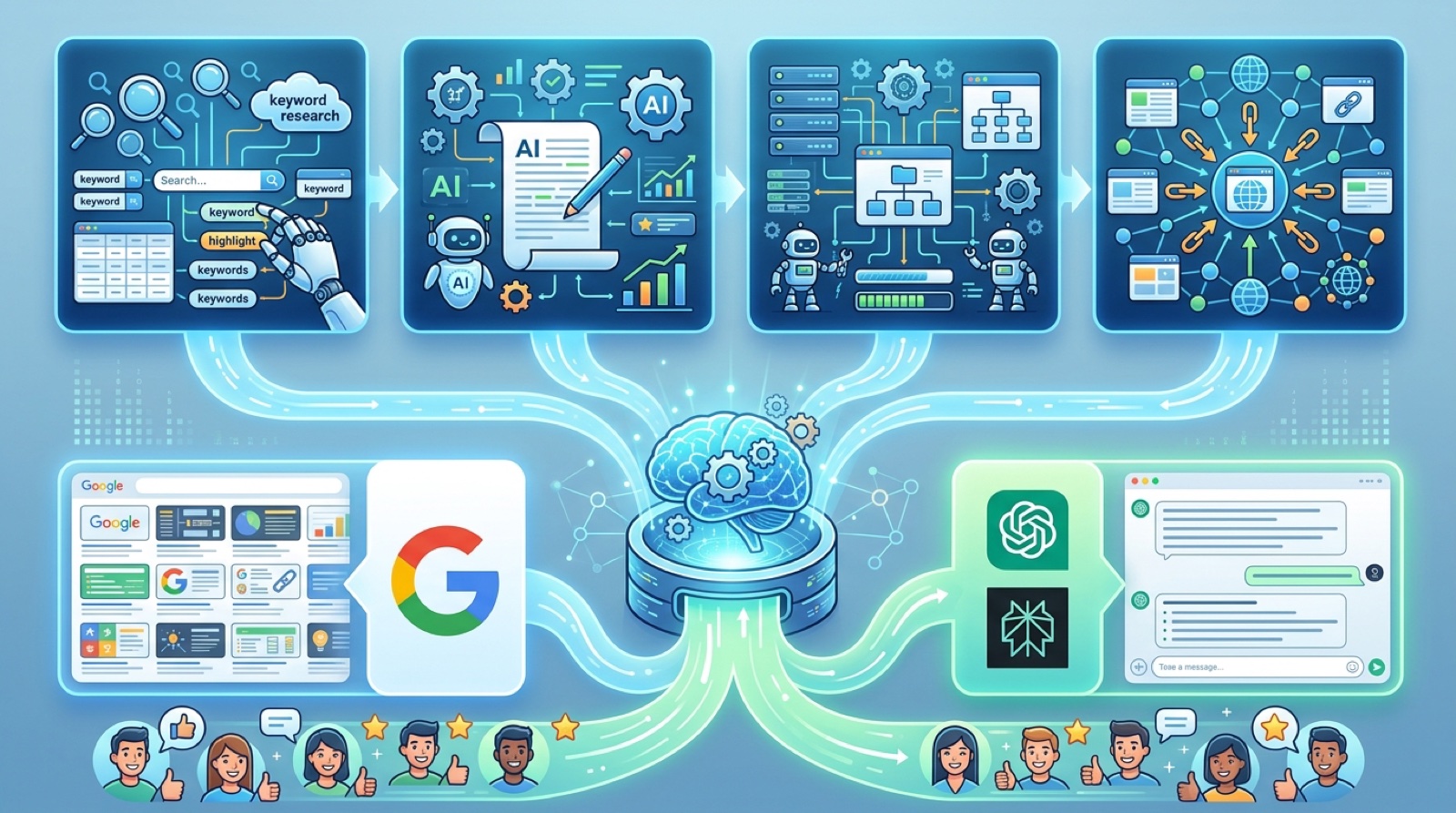
The 2026 AI SEO strategy treats Google rankings, AI Overviews, ChatGPT citations, and Perplexity answers as 4 separate layers.
Three things changed in late 2025 that broke the old SEO playbook.
Google AI Overviews became the default. Google rolled AI Overviews to 100% of US queries in October 2025. Roughly 47% of informational searches now show an AI generated answer above the blue links. Click through rates on position 1 dropped from 28% to 19% on queries with an AI Overview. The only way to recover that traffic is to get cited inside the Overview itself, which requires structured content, schema, and clean factual writing. The old “rank #1 and win” playbook does not work the same way anymore.
ChatGPT Search hit 400 million weekly users. OpenAI made ChatGPT Search the default in mid 2025 and crossed 400 million weekly active users by Q1 2026. Perplexity passed 50 million. Together they eat about 8% of US search volume, growing 4 to 6 points per quarter. If your content is not optimized to be cited by an LLM, that traffic does not exist for you.
AI generated content saturated the SERPs. Every competitor is publishing AI assisted content. The bar moved from “have content” to “have content that is more original, more specific, and more authoritative than the AI generated baseline.” Strategy now matters more than execution speed.
The teams that adapt win the next 24 months. The teams that keep running the 2023 playbook lose 30 to 50% of their organic traffic to AI Overviews and never get it back.
The first layer is still Google blue link rankings. AI Overviews steal clicks but classic blue link traffic still drives 50 to 70% of organic for most sites. The fundamentals have not changed: keyword research, content briefs, on page optimization, technical SEO, link building, and rank tracking. AI accelerates every step but the discipline is the same.
The 2026 update is that classic SEO now requires a stronger original research and proof point layer to compete with AI generated competitor content. Read AI SEO content for the QA process that separates rankable content from AI slop.
Layer 2 optimizes for being cited inside the AI Overview that appears above the blue links. The signals AI Overviews use for citations include schema markup (especially Article, FAQPage, HowTo), structured content with clear headings, factual claims that can be verified, and authority signals from links and brand mentions.
The tactical playbook for layer 2 includes: rewriting page openings to answer the target query in the first 200 words, injecting FAQ schema on every page, adding HowTo schema on procedural content, using clean factual language with specific data points, and structuring H2s as direct answers to common questions. Read AI SEO audit for the page level checklist.
Layer 3 optimizes for being cited inside ChatGPT, Perplexity, Claude, and Gemini when users ask the AI a question. This is brand new in 2025 and most SEO teams are still figuring it out.
The signals LLMs use for citations are different from Google. LLMs prefer content with clean factual statements, named entities, statistics with sources, and clear authoritative voice. They penalize hedge language, marketing fluff, and self promotional copy. The tactical playbook includes: writing in a confident expert voice, citing real sources for every claim, using named entities (companies, people, products) instead of generic descriptions, and structuring content as standalone facts that can be quoted out of context.
Tools that track LLM citations include Profound, Otterly, Semrush AI Toolkit (Perplexity), and Ahrefs AI Content Helper (ChatGPT). Read AI SEO tools for the full tracking stack.
Layer 4 is the smallest layer but the easiest win. Google’s People Also Ask box appears on 80%+ of informational queries in 2026. Each PAA question is a separate ranking opportunity that does not require ranking the parent page #1.
The tactical playbook is straightforward: identify every PAA question for your target keyword (use AlsoAsked and AnswerThePublic), include all the questions in your article as H3 subheadings, write 40 to 80 word direct answers under each, and inject FAQ schema with the question/answer pairs. The result is multiple PAA placements per article instead of one ranking position.

The 4 layer AI SEO strategy. Each layer has its own tactics, tools, and tracking.
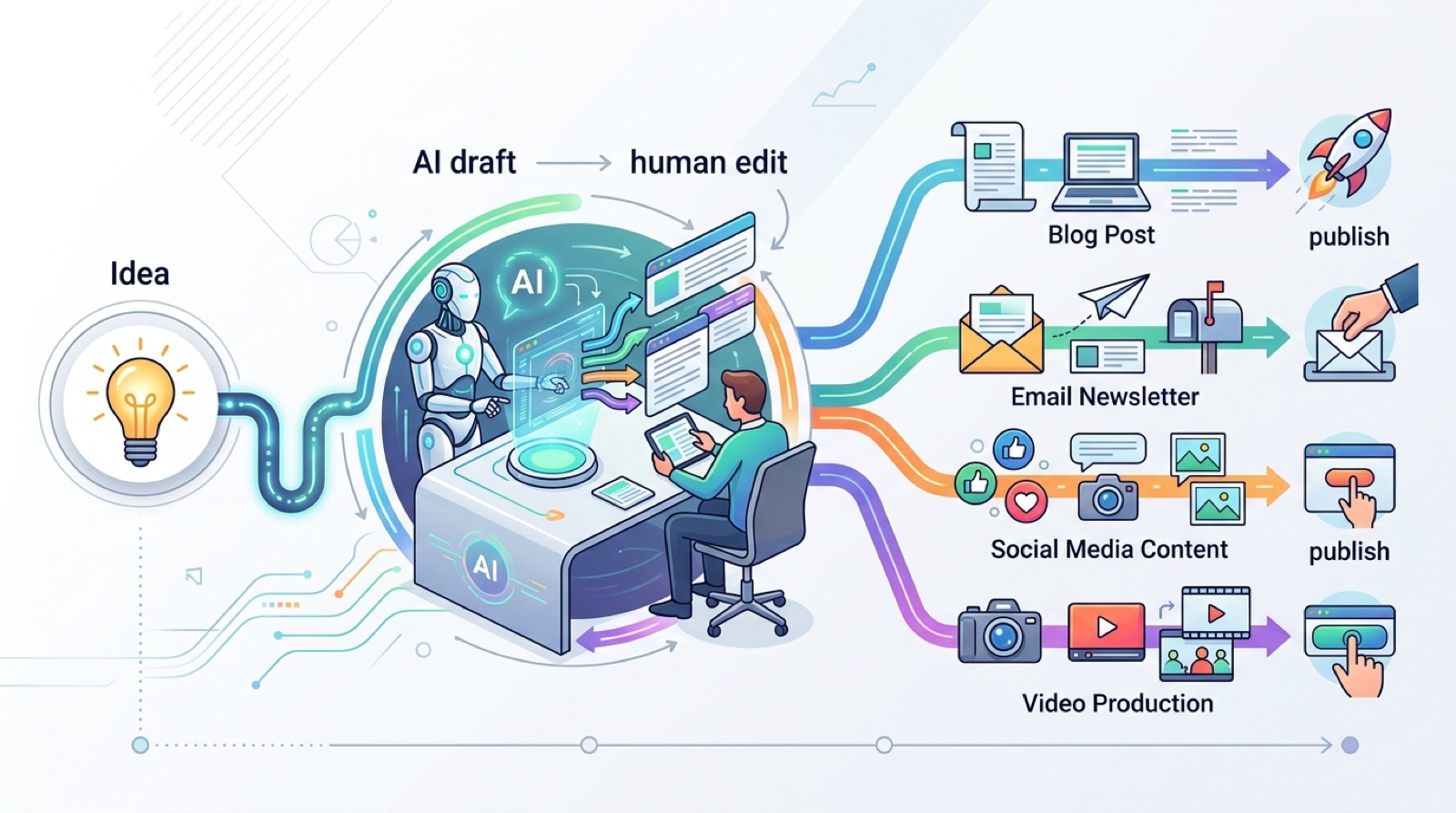
A real AI SEO strategy is not just tactics. It is a content engine that produces consistently rankable output at scale. The engine has 7 stages.
Stage 1: Keyword strategy. Use AI keyword research (Semrush AI, Ahrefs AI, AlsoAsked) to identify 50 to 500 target clusters scored by intent and value. See AI keyword research.
Stage 2: Content brief generation. Use Surfer SEO, Frase, or Clearscope to generate a complete brief per target keyword in 60 seconds.
Stage 3: AI assisted draft. Use Surfer AI, Frase, or Koala AI to write the first draft against the brief. Read AI SEO writer for tool comparison.
Stage 4: Human edit pass. A human editor adds case studies, original research, brand voice, and proof points. This is where 80% of the quality lives.
Stage 5: Optimization. Run the draft through the scoring engine (Surfer or Clearscope) and tune until it hits 75+ for the target keyword.
Stage 6: Schema and internal linking. Add FAQ, Article, and HowTo schema. Add 8 to 12 internal links to pillar pages and sibling content.
Stage 7: Publish, track, iterate. Push to CMS, submit to GSC, track rankings and citations through SE Ranking or Profound, refresh underperformers every 90 days.
A team running this engine ships 8 to 16 articles per month. A team without an engine ships 1 to 2.
The strategy builds your traffic. Your phone is ringing. Most service businesses miss 30 to 50% of inbound calls. CallSetter AI deploys an AI voice agent on your line in 48 hours so the leads your SEO produces actually become booked appointments. Read AI marketing for the broader stack and AI content for the writing layer.
Your AI SEO strategy depends on what stage your business is in.
Goals: 4 to 8 articles per month. Keyword research and tracking inside one tool. Maximum leverage per dollar.
Stack: ChatGPT Plus + AlsoAsked + Frase. Total cost: $60 per month.
Strategy focus: Hit layer 1 (classic Google) hard. Add layer 4 (AEO) on every article. Save layers 2 and 3 for after you have 50 articles published.
Time investment: 60 to 120 minutes per article.
Goals: 8 to 16 articles per month. Track Google plus Perplexity rankings. Build cluster authority in 2 to 3 categories.
Stack: Ahrefs Standard + Surfer SEO + AlsoAsked + ChatGPT Plus. Total cost: $400 per month.
Strategy focus: Hit layers 1 and 4 on every article. Add layer 2 (AI Overviews) on top 20 commercial pages. Pilot layer 3 (LLM citations) on 5 high value pages and measure.
Time investment: 4 to 8 hours per article including human editing.
Goals: 16 to 50 articles per month. Track all 4 layers across multiple LLMs. Compete in high difficulty categories.
Stack: Conductor AI or BrightEdge + Profound + Clearscope + AlsoAsked + Claude Pro. Total cost: $4,000 to $8,000 per month.
Strategy focus: All 4 layers on every article. Dedicated GEO specialist on the team. Quarterly LLM citation strategy reviews.
Time investment: Full time content team.
Old SEO measured rankings. New SEO measures four things across four layers.
Layer 1 metrics: Tracked keyword rankings in Google, organic clicks from GSC, organic conversions from GA4 or HubSpot.
Layer 2 metrics: AI Overview citation rate (manual sampling or Profound), click through rate on queries with AI Overviews, brand mention rate inside AI Overviews.
Layer 3 metrics: ChatGPT citation rate (Profound or Otterly), Perplexity citation rate (Profound or Semrush AI Toolkit), brand mention frequency across LLMs.
Layer 4 metrics: PAA placement count per article, PAA click through rate (estimated from GSC).
The aggregate metric we use with clients is “share of search” across all 4 layers, expressed as a percentage of buyer queries where your brand appears in any answer surface.

Six mistakes we see most often when teams try to implement AI SEO without a real strategy.
Publishing raw AI output without human editing. The fastest way to eat a Helpful Content Update. Always human edit. Always.
Ignoring schema markup. Schema is the highest leverage technical SEO move in 2026 because LLMs use it to decide what to cite. If you skip schema, you lose layers 2 and 3.
Tracking only Google rankings. If you do not track AI Overview citations, ChatGPT mentions, and Perplexity answers, you are flying blind on 30% of your potential traffic.
Skipping the brief. Drafting without a brief produces inconsistent quality. Always brief first.
Buying tools without a workflow. Tools without workflow is wasted spend. Build the engine first, then buy the tools that fill specific gaps.
Hiring an agency that does not track LLM citations. In 2026 this is a deal breaker. Read AI SEO agency for the full vetting checklist.

The 6 mistakes that separate teams winning at AI SEO from teams losing 30% of their traffic to AI Overviews.
If you are starting from zero, here is the 90 day plan.
Days 1 to 14: Foundation. Run a technical audit. Set up GSC and GA4 baseline. Pick your tool stack. Define 3 target keyword clusters.
Days 15 to 30: First batch. Generate briefs for 8 articles. Draft, edit, publish. Submit to GSC. Add schema. Build internal links.
Days 31 to 60: Cadence. Ship 8 to 12 more articles. Set up rank tracking and LLM citation monitoring. Run the first monthly report.
Days 61 to 90: Optimization. Identify the top performing articles. Build follow up content in the same clusters. Refresh any underperformers. Add layer 2 and 3 optimization to top pages.
Day 90: First measurable lift. You should see new rankings on long tail queries, your first AI Overview citations, and 20 to 50% increase in tracked keyword positions.
What is AI SEO strategy in simple terms?
A plan for ranking content using AI tools for execution and human judgment for strategy. The 2026 version covers 4 layers: Google blue links, Google AI Overviews, ChatGPT and Perplexity citations, and People Also Ask placements.
How is 2026 AI SEO strategy different from 2024?
2024 focused on Google rankings only. 2026 adds AI Overviews, LLM citations, and AEO as equally important layers. The tactics are different and the tracking tools are different.
Do I need a separate strategy for ChatGPT vs Google?
The content can overlap but the optimization tactics differ. ChatGPT prefers clean factual statements and named entities. Google AI Overviews prefer schema markup and structured headings. Most articles can be optimized for both.
How long does AI SEO strategy take to show results?
Rankings lift by month 3, traffic lift by month 6. AI Overview citations can appear in 4 to 8 weeks for cleanly structured content. ChatGPT and Perplexity citations take 60 to 90 days because the LLMs index content slower than Google.
Can a solo SEO run a full 4 layer AI SEO strategy?
Yes. The stack costs $60 per month (ChatGPT Plus + AlsoAsked + Frase) and the workflow is repeatable. The constraint is time, not budget. Read AI SEO tools for the budget stack.
Should I update existing content or write new content?
Both. Refresh your top 20 organic landing pages with layer 2 and 3 optimization. Write new content for cluster gaps. The mix is usually 70% new, 30% refresh.
What if my industry is too niche for AI Overviews?
Niche industries actually win bigger because the SERPs are less competitive. AI Overviews appear less often on niche queries, which means classic Google rankings drive more traffic. Focus on layers 1 and 4.
How do I know if my AI SEO strategy is working?
Monthly metrics across all 4 layers: tracked keyword rankings, AI Overview citation rate, ChatGPT and Perplexity mention frequency, PAA placement count. If any of the 4 are climbing, the strategy is working.
Ready to ship? Book a CallSetter AI demo and have an AI voice agent answering the calls your SEO traffic is about to generate. Live in 48 hours.
Reviewed April 2026 by Victor Smushkevich, CEO of Tested Media. Victor has been profiled in Forbes, HuffPost, and MarketWatch.
Talk with one of our SEO specialists today and see how we can supercharge your marketing campaigns!