TL;DR AI content creation in 2026 is no longer a debate about whether to use it. It is a question of which tool stack, which workflow, and which guardrails. The winners pair a writing tool (Jasper, Copy.ai, Writesonic, or ChatGPT and Claude direct), an optimization layer (Surfer SEO, Frase, or Clearscope), and a human editor who enforces brand voice. Done right, the cost per published article drops from $300 to $40 and the velocity goes from 4 a month to 40. Done wrong, you get a Helpful Content Update penalty and watch your traffic disappear in a week. If you want the traffic that AI content brings to actually convert into booked calls, CallSetter AI answers every inbound call from your new pages with a voice agent that books appointments around the clock.
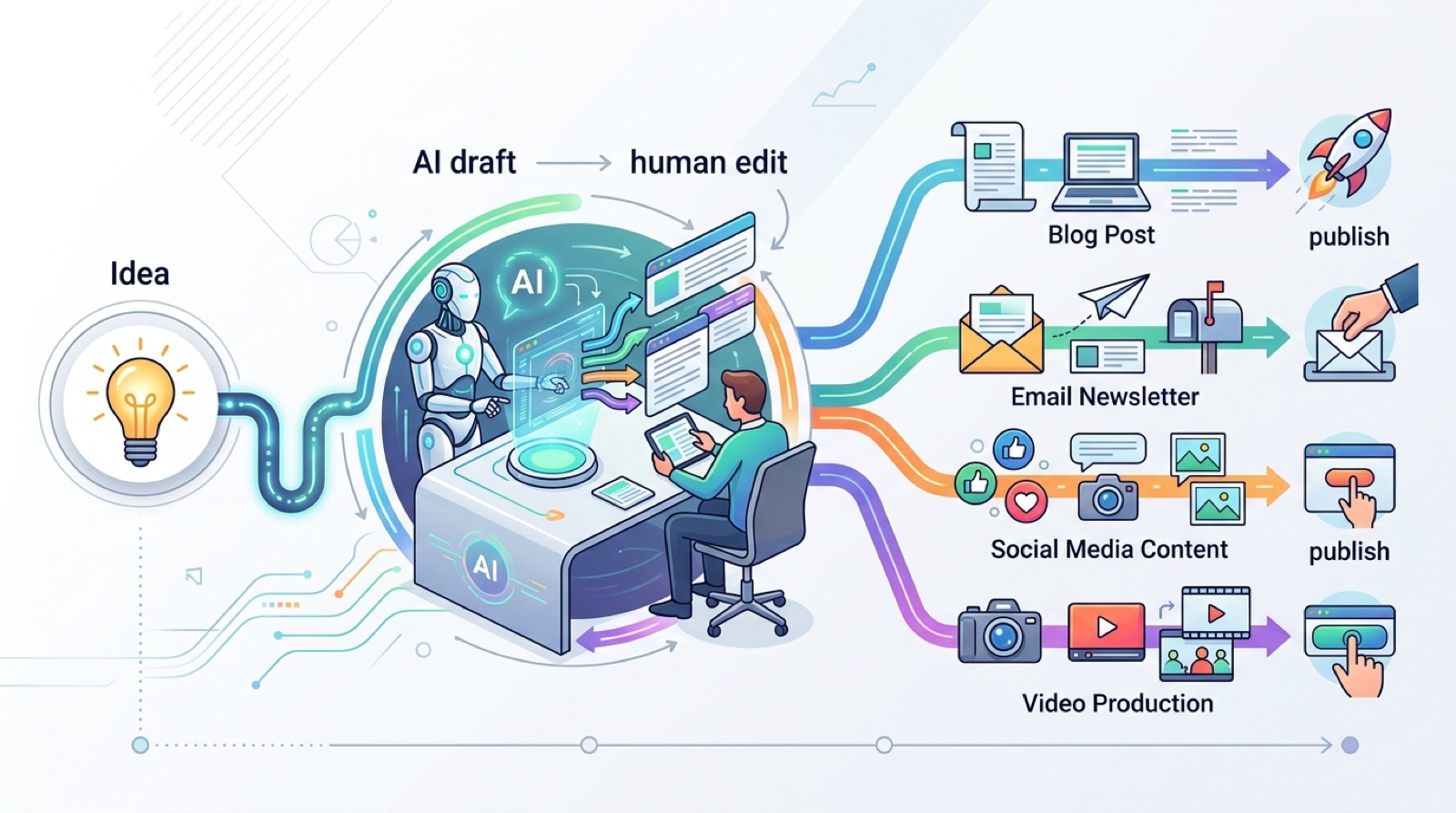
The 2026 AI content stack pairs a writing tool, an optimization layer, and a human editor. The combo is what separates pages that rank from pages that get penalized.
What “AI content creation” means in 2026
AI content creation is the use of large language models, image generation models, and voice models to produce written, visual, and audio content at a fraction of the time and cost of manual production. In 2026 the term covers six activities that used to be separate disciplines.
- Long form writing. Blog posts, pillar pages, white papers, and ebooks generated with a model and edited by a human.
- Short form copywriting. Ad copy, email subject lines, headlines, and social captions produced in batches from a brief.
- Programmatic content. Templated landing pages built from a database where the model fills the variable sections at scale.
- Image generation. Hero images, illustrations, product mockups, and social graphics from text prompts.
- Video and voice. AI avatars, voice cloning, automated voiceovers, and short form video from script to final cut without a camera.
- Repurposing. Turning a single source asset into 20 derivative pieces across formats and channels.
The technology underneath all six is the same family of foundation models. A general tool like ChatGPT or Claude can do any of these if you know how to prompt. A specialized tool like Jasper or Surfer SEO bakes the prompts into a product so a non technical marketer can ship without learning prompt engineering. In 2026 the gap between general models and specialized tools narrowed. The buying decision is less about raw quality and more about which interface fits your workflow.
The categories of AI content tools
There are seven categories of AI content tools that matter in 2026. Most teams need at least three of them.
1. AI writers. The core category. Tools that take a brief, an outline, or a few keywords and produce a draft. Examples: Jasper, Copy.ai, Writesonic, Anyword, Rytr, Sudowrite, Koala AI, Junia AI, Article Forge, AI Writer.
2. AI content optimizers. Tools that score a draft against the top 10 ranking pages for a target keyword and tell you what to add. They are not writing tools, they are coaching tools. Examples: Surfer SEO, Frase, Clearscope, MarketMuse, NeuronWriter, Outranking.
3. AI editors and humanizers. Tools that take an AI draft and rewrite it to read more naturally, fix tone issues, and pass detection. Examples: Originality.ai, Undetectable AI, QuillBot, Wordtune.
4. AI image generators. Tools that create visuals from text prompts. Examples: Midjourney, DALL-E, Stable Diffusion, Ideogram, Flux, nano-banana (Gemini’s image model).
5. AI video tools. Tools that build video from a script, an avatar, and a voice. Examples: Synthesia, HeyGen, Runway, Pictory, Descript.
6. AI voice tools. Tools that generate human sounding voiceovers, podcast hosts, and dubbed audio. Examples: ElevenLabs, Cartesia, PlayHT, Murf.
7. AI repurposers. Tools that take a long form asset and chop it into clips, threads, posts, and emails. Examples: Letterdrop, Byword, Opus Clip, Repurpose.io.
Most of the noise in the AI content space is in category 1. Most of the leverage is in combining categories 1, 2, and 7 with a disciplined human review step. Skip the optimization layer and you produce drafts that read fine but never rank. Skip the human review and you produce drafts that look right and then get penalized.
Compare every category in detail in our AI content tools breakdown.
Top AI writing tools compared

Six tools own the AI writing category in 2026. We have used all of them in client production over the last 12 months. Here is the head to head.
| Tool | Starting price | Best for | Free trial |
|---|---|---|---|
| Jasper | $49 per month | Marketing teams that need brand voice memory and templates | 7 day trial |
| Copy.ai | $49 per month | Sales and marketing workflows with prebuilt automations | Free plan, 2,000 words |
| Writesonic | $20 per month | SEO heavy long form articles with built in optimizer | Free plan, 25 generations |
| Anyword | $49 per month | Performance marketers who need predictive scoring | 7 day trial |
| Rytr | $9 per month | Solo creators on a budget | Free plan, 10K characters per month |
| Sudowrite | $19 per month | Fiction writers and narrative content | 30 day trial |
Read our full Jasper AI review, Copy.ai review, and Writesonic review for the deep dives.
Quick picker
- Marketing team that needs brand voice consistency? Jasper. Brand Voice memory and templates are the strongest in the category.
- Sales and marketing org with handoff workflows? Copy.ai. The Workflows feature chains prompts and passes output between teammates.
- Long form SEO content as your main channel? Writesonic. Article Writer 6 pulls live SERP data and builds a draft against the top 10.
- Spending on paid ads and need predictive copy scoring? Anyword. The Predictive Performance Score ties output to ad performance data.
- Solo creator on a tight budget? Rytr. $9 a month for unlimited use is unbeatable.
- Writing fiction or narrative content? Sudowrite. The only tool in the category built for story craft.
- Want a done for you content engine on top of these tools? Tested Media builds and runs the whole stack and feeds the traffic into CallSetter AI.
The differences between these tools are smaller than the marketing pages claim. Output quality on a generic prompt is within 10% across all six. The real differentiator is workflow, brand voice control, and integrations. Pick the one that fits how your team already works.
ChatGPT and Claude vs dedicated AI writing tools
The most common question we get from marketing teams in 2026. Why pay $49 a month for Jasper when ChatGPT Plus or Claude Pro give you the underlying model for $20?
Use ChatGPT or Claude direct if your team is technical enough to write good prompts, you have one or two writers, you do not need brand voice memory across sessions, and you want the latest model the day it ships.
Use a dedicated AI writing tool if your team includes non technical marketers, you need brand voice consistency across writers, you publish more than 10 pieces a month, and you need approval workflows and team permissions.
ChatGPT Plus at $20 gives you GPT 5.4 with unlimited use. Claude Pro at $20 gives you Claude Opus 4.6, arguably better for long form. Jasper at $49 gives you the same models underneath plus templates, brand voice training, SEO integration, and team features. The dedicated tools are not selling the model. They are selling the wrapper. If you do not need the wrapper, save the money. If your team needs it, the $30 delta is the cheapest hire you will ever make.
A note on Perplexity. It is a research tool, not a writing tool. We use it as the research layer in front of ChatGPT or Claude. Ask Perplexity for data and citations, then feed that into the writing model as context. This produces drafts far more accurate than asking either model to write from training data alone.
The 5 AI content workflows that actually work
Most teams fail at AI content because they treat it as “ask the model to write a blog post and publish it.” That produces generic drafts nobody reads. The teams that win in 2026 use one of these five workflows.
Workflow 1: Long form blog post
For a 2,000 to 4,000 word pillar article or in depth blog post.
- Research with Perplexity. Get the current state of the topic, the top 10 ranking articles, and any stats you want to cite. Save the citations.
- Build the outline manually. Do not let the model write the outline. Identify the gaps in the top 10 and write an outline 20% deeper than what is out there.
- Run the outline through Surfer SEO or Frase. Get the target word count, entities to mention, and the H2s the SERP expects.
- Generate section by section in Claude or Jasper. Feed the model the outline, the brand voice, and one section at a time. Never the full article in one shot.
- Edit ruthlessly. Cut every sentence that does not earn its place. Add examples, numbers, and experience the model cannot know.
- Optimize against Surfer or Clearscope. Get the score above 80 before publishing.
- Add the human details. Author bio, screenshots, internal links, schema, and a call to action.
This takes 4 to 6 hours per article instead of 12 to 20. The model handles the bulk writing while the human focuses on what actually matters.
Workflow 2: Programmatic landing pages
For hundreds or thousands of templated pages like city pages, comparison pages, or product variants.
- Build the data source: one row per page, columns for every variable.
- Write the master template with placeholders like
{{city}},{{population}}. - Script the model call for the variable sections, 200 to 400 words of custom intro and a few unique sections per row.
- Save every output to disk before publishing.
- Manually review a sample of 20. If more than one in 20 has problems, fix the prompt and regenerate.
- Add schema markup that matches the page type.
This scales to 10,000+ pages. Google penalizes pure templates with no unique value, so every page needs at least one section that could not have been generated for any other variant.
Workflow 3: Social media batch
For producing 30 days of posts in a single afternoon.
- Define three to five content pillars your brand owns.
- Brainstorm 100 hooks in ChatGPT or Claude. Short, scroll stopping first lines.
- Pick the 30 best manually. The human filter matters most here.
- Expand each into a full post in your brand voice using Jasper, Copy.ai, or Claude with a system prompt.
- Generate matching images in Midjourney, Ideogram, or nano-banana.
- Schedule in Buffer, Hypefury, or your platform of choice.
The whole batch takes 3 to 5 hours and replaces 20+ hours of one off creation.
Workflow 4: Email sequence
For a 5 to 10 email nurture or sales sequence.
- Define the action you want by the end of the sequence.
- Map the emotional arc. Hook, build, offer, handle objections, close.
- Write the first email manually to set the voice.
- Use Copy.ai or Anyword to expand into the full sequence with the first email as a voice sample.
- Optimize subject lines with Anyword’s Predictive Performance Score.
- A/B test the first two emails. They make or break the open rates.
Workflow 5: Video script and voiceover
For short form video and explainer content.
- Write the script in Claude or ChatGPT with explicit pacing and visual cues.
- Generate the voiceover in ElevenLabs or Cartesia.
- Build visuals with stock footage, an avatar tool like HeyGen or Synthesia, or B roll from Runway.
- Assemble in Descript or CapCut.
- Publish with auto generated, manually corrected captions.
A 90 second explainer that used to cost $500 to $2,000 in production now takes $20 in tool costs and 90 minutes of work.
Read the full breakdown of every AI content writer and see which AI blog writer fits your stack.

Workflow diagram: long form blog post production with Perplexity, Claude, Surfer, and human editor
The long form blog post workflow that produces ranking content in 4 to 6 hours instead of 12 to 20.
AI content optimization tools

Writing the draft is half the job. Making sure the draft can rank is the other half. This is where AI content optimization tools earn their keep. They scrape the top 10 ranking pages for a keyword, extract the entities, headings, word count, and topical structure, then score your draft against that benchmark.
Surfer SEO. The most popular tool. Strong content editor, integrated outline builder, and a Content Score that maps to ranking probability. $89 per month. Best for teams publishing more than 10 pieces a month.
Frase. Cheaper with a stronger AI writer built in. $45 per month. Best for solo marketers who want optimization and writing in one tool.
Clearscope. The premium option. Most accurate scoring and cleanest interface. $189 per month. Best for in house content teams with budget.
MarketMuse. Deepest topic modeling. Goes beyond keyword optimization into full topic cluster planning. $149 per month. Best for editorial teams that want strategy and optimization combined.
NeuronWriter. European challenger. Similar features to Surfer at half the price. $23 per month. Best for budget conscious teams.
Outranking. Newer entrant with strong AI integration and workflow automation. $129 per month. Best for teams that want writing, optimization, and publishing in one place.
Any of these will work. Pick the one in your budget and use it consistently on every draft. See our full guide to AI content optimization.
AI content for SEO vs AI content for ads vs AI content for brand
Not all AI content is built for the same purpose. The biggest mistake teams make is using the same workflow for all three.
SEO content is optimized for ranking. The metric is organic traffic, the rules are written by Google, and the content needs to be long, comprehensive, and demonstrably valuable. Use Jasper, Writesonic, or Koala AI paired with Surfer or Frase. Structure and entity coverage matter more than voice.
Ad content is optimized for conversion. The metric is CTR and CPA. Use Anyword, Copy.ai, and Koala AI. Anyword’s Predictive Performance Score is the best feature in the category here because it ties output to actual conversion data.
Brand content is optimized for trust and recall. The metric is awareness and sentiment. Use Jasper with Brand Voice, Sudowrite for narrative, or ChatGPT and Claude with a custom system prompt. Generic AI output kills brand content. You need a model that has been trained on your voice.
Teams that mix these up produce ad copy that reads like SEO content and SEO content that reads like brand content. Neither converts. Read more on AI content marketing strategy and the case for an AI copywriter.
AI image generation overview
Images are the part of AI content that improved the fastest in 2025 and 2026. The 2024 generation had obvious tells. The 2026 generation is indistinguishable from professional photography for most use cases.
Midjourney. The gold standard for artistic and stylized images. Version 7 shipped in early 2026 with the best photorealism in the category. $10 per month. Best for hero images and anything that needs to look “designed.”
DALL-E. Built into ChatGPT. Strongest at following complex prompts with text and specific compositions. Free with ChatGPT Plus. Best for quick illustrations.
Stable Diffusion. The open source option. Self hosted or run on Replicate. Best for teams that need full control, custom model training, or low cost batch generation.
Ideogram. The text in image specialist. The only model that reliably renders readable text in generated images. Free tier. Best for typography, posters, and logos.
Flux. The newer challenger from Black Forest Labs. Strong photorealism, fast generation, and good prompt adherence. Best for production workflows that need speed and quality.
nano-banana. The Gemini image model. Strong on consistency across multiple generations of the same subject, which is rare in this category. Best for product variations and consistent character generation.
For most marketing use cases, Midjourney and DALL-E cover 90% of the need. Add Ideogram for text in image and you have everything. A note on copyright: most platforms grant commercial use rights, but that does not protect you from a third party claim. Avoid prompting in the style of named living artists.
AI video and voice tools

Video and voice are the newest frontier and the fastest moving. The 2026 generation is shipping in production at major brands.
Synthesia. The leader in AI avatar video. Write a script, pick an avatar and voice, get a finished video in minutes. Supports 140+ languages. $29 per month. Best for training videos, internal comms, and explainers.
HeyGen. The strongest Synthesia competitor. Better lip sync, more diverse avatars, and built in voice cloning. $24 per month. Best for marketing video and social content.
Runway. Generative video. Short clips from text prompts or extended from existing footage. $15 per month. Best for B roll, transitions, and creative video.
ElevenLabs. The voice synthesis leader. Voiceovers, audiobooks, and dubbed audio in dozens of languages, indistinguishable from a human actor. $5 per month. Best for podcast intros and video voiceovers.
Cartesia. The newer voice model. Lower latency than ElevenLabs and competitive quality. Best for real time applications like voice agents. We use Cartesia inside CallSetter AI for the lowest latency on inbound calls.
The use case that exploded in 2026 is the AI avatar talking head video for SaaS marketing pages. A 30 second video that used to require a studio and a $500 voice actor now takes a single prompt and a script.
Content quality at scale: the trap of speed without standards
The single biggest failure mode of AI content in 2026 is teams that cranked up the volume without a quality bar. They saw the speed, removed the human review step, and three months later their organic traffic crashed. This trap has killed more content sites in the last 12 months than any algorithm update.
The fix is to define the quality bar before you scale. Run every draft through the four question test:
- Does this say something specific the reader could not get from the first 10 results in Google? If no, kill it.
- Does this include data, examples, or experience that proves the writer knows the topic? If no, send it back.
- Does this read like a human wrote it for another human? If no, edit it.
- Would I send this to a friend who asked about the topic? If no, do not publish.
If you can answer yes to all four, ship it. If you cannot, fix it. If you cannot fix it, kill it. This is the difference between teams that scale to 100+ articles a month and rank, and teams that scale to 100+ articles a month and lose all their traffic.
AI content and Google: what works in 2026
Google has been clear since the March 2024 Helpful Content Update and the August 2024 Core Update. They do not penalize AI content for being AI. They penalize content that is low value, regardless of source.
The signals that matter are the same as they have always been: original insight, deep topical coverage, demonstrable expertise, and a clear answer to the reader’s actual question.
What works:
- AI assisted long form with clear human editing. The dominant pattern for sites that survived 2024 and 2025.
- Programmatic content with unique data per page. Pure templates with only the city name swapped died.
- AI drafts with first person experience layered on top: stories, screenshots, numbers nobody else has.
- AI content optimized with Surfer or Clearscope and then humanized. The combo ranks.
What does not work:
- Pure AI output with no human edit. Detected, scored low, deindexed.
- AI content that copies the top 10 structure without adding anything.
- Fabricated statistics and citations. Manual action risk.
- AI generated images presented as photographs of real events or people.
- AI generated reviews of products the writer never used.
The shortcut of “write 1,000 articles and publish” is dead. The strategy of “write 100 articles and edit each to be 10x better than the alternative” is the winning move. Read our companion piece on AI SEO in 2026.
The 5 mistakes that get AI content penalized
After auditing 200+ sites that lost traffic in 2024 and 2025, these are the patterns we see kill rankings.
1. No human edit pass. The draft is generated, lightly proofed, and published. Google detects the patterns and ranks the page low. Fix: a mandatory edit step where every paragraph gets touched.
2. Same template for every page. Programmatic pages where every city or product reads identically except for the variable name. Fix: at least one unique section per page.
3. Fabricated facts and citations. The model invents a statistic that does not exist. Fix: fact check against Perplexity before publishing.
4. Generic, voiceless writing. No brand voice was applied. Fix: a system prompt or brand voice training that defines the voice in concrete terms, not adjectives.
5. Publishing volume without quality control. The team scales from 10 to 100 articles a month without scaling editing capacity. Fix: cap volume at the rate editing can keep up with. Quality is the constraint.
If any of these sound like your workflow, fix them now. A site with 50 mediocre AI articles can lose all its traffic in a single core update.
ROI math: real numbers
Here is the honest cost comparison for a marketing team producing 20 articles a month.
Fully manual baseline.
- 1 in house writer at $5,000 a month produces 8 articles a month
- 1 freelance writer at $250 per article produces 12 articles a month
- Editor and SEO review at $50 per article: $1,000
- Total: $5,000 + $3,000 + $1,000 = $9,000 a month for 20 articles
- Cost per article: $450
AI assisted, properly done.
- Tool stack: Jasper $49 + Surfer $89 + Claude Pro $20 + Midjourney $30 = $188 a month
- 1 in house writer/editor at $5,000 a month produces 20 articles a month with AI assist
- Image and graphic generation included in tool stack
- Total: $5,000 + $188 = $5,188 a month for 20 articles
- Cost per article: $259
AI assisted, scaled.
- Same tool stack: $188 a month
- 2 in house writer/editors at $10,000 a month produce 60 articles a month with AI assist
- Total: $10,188 a month for 60 articles
- Cost per article: $170
AI heavy with light editing (do this only if you have the quality control to support it).
- Same tool stack: $188 a month
- 1 editor at $5,000 a month reviews and approves 100 articles a month
- Total: $5,188 a month for 100 articles
- Cost per article: $52
The math is obvious. The risk is real. The teams that get the math without the risk are the ones that built the editorial process before they scaled the generation.
See how Tested Media handles content production for clients and how an AI marketing agency turns the math into actual traffic.
Once the traffic shows up, the next bottleneck is the phone. Most service businesses miss 40% of inbound calls because they happen after hours or while the front desk is busy. CallSetter AI answers every call with a voice agent that books appointments, qualifies leads, and routes the urgent ones to a human. Pair AI content with AI voice and you have a business that captures every opportunity the marketing creates.
AI content agency vs DIY vs in-house writers
The right answer depends on three things: how much content you need, what your team looks like today, and how fast you need to ramp.
Hire an agency if you need 20+ pieces a month live this quarter, you do not have a content lead with AI tool experience, and you want one bill instead of five subscriptions and a freelancer roster.
Do it yourself if you publish 4 to 8 pieces a month, you enjoy writing, and budget is the main constraint.
Build in house if you publish 30+ pieces a month long term, content is a core strategic moat, and you have a content lead who can hire and manage a team.
Most teams in 2026 are best served by an agency for the first six months, then a hybrid with an in house lead and agency support for overflow. See how Tested Media works and why an AI content marketing engine pays for itself in months.

AI content team workflow showing strategy, generation, editing, optimization, and publishing
The five stage AI content workflow that turns a 12 hour article into a 4 hour article without sacrificing quality.
Frequently asked questions
Will Google penalize my site for using AI content?
No, not for using AI. Google penalizes low quality content regardless of source. Well edited, accurate, useful AI content ranks fine in 2026. Generic, fabricated, or templated AI content gets penalized.
What is the best AI writing tool in 2026?
There is no single best. Jasper for marketing teams with brand voice needs, Copy.ai for workflow chains, Writesonic for SEO long form, Anyword for ads, Rytr for solo creators on a budget, Sudowrite for fiction. Read our best AI content writer breakdown.
How much does an AI writing tool cost?
Free tiers exist for Rytr, Writesonic, and Copy.ai. Paid plans range from $9 a month for Rytr to $189 for Clearscope. Most teams spend $150 to $300 a month on a full stack of writer plus optimizer plus image generator.
Can AI content rank on Google?
Yes, with the right workflow. AI assisted content with human editing and optimization ranks the same as fully manual content. Pure AI output without human edit ranks poorly.
Is AI content detection accurate?
Detection tools like Originality.ai, GPTZero, and Copyleaks catch obvious AI output but miss well edited drafts. Google does not use these tools. Do not pay to humanize AI content. Pay to edit it well.
How long does it take to write a blog post with AI?
A 2,000 word optimized post takes 4 to 6 hours with AI assist versus 12 to 20 hours manual. The model handles the bulk drafting while the human focuses on outline, examples, and editing.
Should I use ChatGPT, Claude, or a dedicated AI writing tool?
Use ChatGPT or Claude direct if your team is technical. Use Jasper or Copy.ai if your team needs templates, brand voice control, and team workflows. The choice is about workflow fit, not output quality.
What is the biggest mistake teams make with AI content?
Scaling generation without scaling editing. Cap publishing volume at the rate your editing team can keep up with.
Related reading
Tool deep dives:
Category guides:
- AI Writing Tool Buyer’s Guide
- AI Writing Assistant Comparison
- AI Copywriting in 2026
- AI Copywriter for Performance Marketing
- AI Content Writer Buyer’s Guide
- AI Blog Writer Comparison
- AI Content Generator Buyer’s Guide
- AI Content Tools Master List
- AI Content Marketing Strategy
Cross silo:
Done for you:
- Tested Media AI Content Production
- CallSetter AI – Convert your content traffic into booked calls →
This guide is updated quarterly with the latest AI content tools, workflows, and benchmarks. Last review: April 2026 by Victor Smushkevich, CEO and Founder of Tested Media. Victor has been profiled in Forbes, HuffPost, and MarketWatch on AI and digital marketing.
Ready to ship? Talk to the Tested Media team and have an AI content engine plus a CallSetter AI voice agent live by next month. Traffic in, calls answered, appointments booked.
Every Article in Our AI Content Silo
Browse all 13 guides, reviews, and playbooks in the AI Content category. New articles added weekly.
- 4 Simple Ways to Boost Content & Link Building Efforts
- AI Content Generator: 10 Best Tools for Every Content Type in 2026
- AI Content Marketing: The 2026 Playbook for Service Businesses
- AI Content Tools: The Complete 2026 Stack for Marketing Teams
- AI Content Writer: 9 Best Tools and How to Use Them in 2026
- AI Copywriting: How to Write Sales Copy That Converts in 2026
- AI Social Media Content: How to Create 30 Days of Posts in 2 Hours
- AI Writing Assistant: How They Work and the 10 Best in 2026
- AI Writing Tool: The 12 Best Platforms for Content Teams in 2026
- Best AI Content Writer 2026: Head to Head Test of 12 Platforms
- Copy.ai Review 2026: The Best AI for Sales and Outbound Copy?
- Jasper AI Review 2026: Is It Still the Best for Marketing Teams?
- Writesonic Review 2026: The Best Budget AI Writer for SEO?
Related Reading