TL;DR AI voice agents in 2026 cost 80% to 95% less than human receptionists, answer every call within one ring, never sleep, and handle 73% of calls without callers noticing. Human receptionists win on emotional escalation, complex judgment calls, and warm relationship building. The right answer for most service businesses is a hybrid: AI handles the first 80% of calls, humans handle the 20% that need real judgment. CallSetter AI builds the hybrid model so you keep your existing front desk for complex calls and let the AI handle everything else.
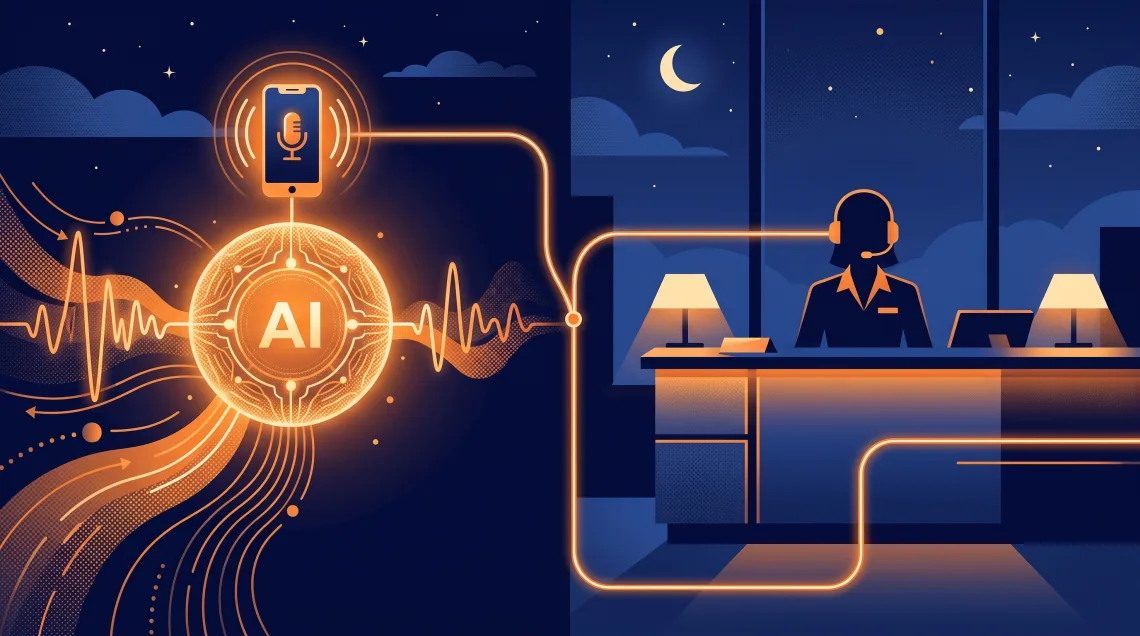
Side by side comparison of AI voice agent vs human receptionist across cost, availability, and quality metrics.
The cost comparison nobody wants to do
Let’s start with the math because it is the most lopsided part of this comparison.
A full time receptionist in the US costs $35,000 to $55,000 per year base salary. Add 25% for benefits, payroll tax, and overhead and the fully loaded cost lands at $44,000 to $69,000 per year. That is $3,667 to $5,750 per month before you factor in PTO, sick days, training, turnover, or coverage gaps.
An AI voice agent for a service business with 200 inbound calls a month at 4 minutes average call length costs $130 to $300 per month all in. That is 96% cheaper than a human receptionist.
Even at 1,000 calls a month, the AI voice agent costs $400 to $700 per month. Still 80% to 90% cheaper than a human.
Here is the side by side for a typical mid sized service business:
| Metric | Human receptionist | AI voice agent |
|---|---|---|
| Monthly cost | $3,667 to $5,750 | $130 to $700 |
| Annual cost | $44,000 to $69,000 | $1,560 to $8,400 |
| Hours covered | 40 per week | 168 per week (24/7) |
| Calls per hour capacity | 8 to 12 | Unlimited (parallel) |
| Sick days | 8 to 12 per year | 0 |
| PTO | 10 to 20 days per year | 0 |
| Turnover replacement cost | $5,000 to $15,000 | $0 |
| Training time | 2 to 4 weeks | 1 to 7 days |
For a 10 location dental chain that currently spends $40,000 a month on front desk staff, switching the inbound call answering layer to AI saves $35,000+ a month while improving call answer times.
For full pricing detail see AI voice agent pricing.
What AI voice agents do better
1. Always available
AI voice agents answer every call on the first ring. No hold music. No “all our agents are busy.” No 30 minute wait during the lunch rush. We measure first ring answer rates of 99%+ across our client deployments. No human can match this.
2. Handle peak volume
When 50 calls come in within the same hour during the busy season, a human receptionist puts 40 of them on hold or sends them to voicemail. An AI voice agent answers all 50 in parallel without any of them waiting.
3. Never have a bad day
A human receptionist who is tired, stressed, or sick will sound that way on the phone. The AI voice agent sounds the same on call 1 and call 1,000.
4. After hours coverage
Service businesses lose 30 to 50% of inbound calls because they happen between 5 PM and 8 AM. An AI voice agent answers those calls and books morning appointments. This is the #1 ROI driver across our client deployments.
5. No turnover
The average front desk receptionist turnover rate in service businesses is 50% to 75% per year. Each replacement costs $5,000 to $15,000 in recruiting, training, and lost productivity. AI voice agents do not quit.
6. Consistent compliance
Required disclosures, recording notifications, intake questions. The AI voice agent says exactly what it is supposed to say every time. Human receptionists drift over time and forget the script.
7. Multi language coverage
Spanish, French, Mandarin, German. The AI voice agent handles them natively with zero training. Hiring multilingual receptionists is expensive and slow.
8. Perfect call records
Every call gets a full transcript, structured data extraction, and audio recording automatically. Human receptionists take partial notes that get lost.
9. Faster speed to lead
When a web form lead comes in, the AI voice agent can call them back in under 60 seconds. A human receptionist takes 4 to 24 hours. Speed to lead is the single biggest driver of conversion in AI sales. See speed to lead for the data.
10. No sick days, no PTO, no overtime
Self explanatory.
Want the AI voice agent built without firing your front desk? CallSetter AI builds the hybrid model. AI handles the first 80% of calls. Your front desk handles the rest.
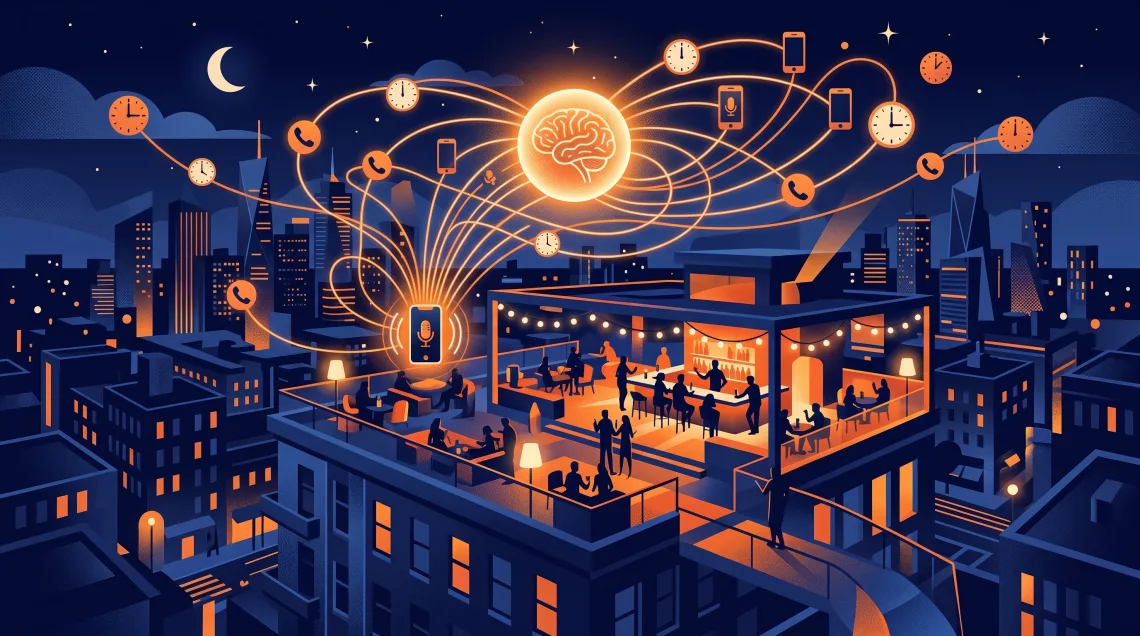
The 10 measurable advantages of AI voice agents over human receptionists in 2026.
What human receptionists do better

Let’s be honest. There are situations where a human receptionist is the right answer.
1. Emotional escalation
When a caller is angry, distressed, or grieving, a skilled human receptionist can defuse the situation in ways an AI cannot. The AI can sound empathetic but it does not actually understand the emotion. For high stakes emotional calls, route to a human.
2. Complex judgment calls
When a regular client calls with an unusual request, a human receptionist who knows that client can make a judgment call. The AI follows the script.
3. Building long term relationships
Some service businesses (concierge medicine, high end real estate, luxury hospitality) build their brand on personal relationships with the front desk. The receptionist remembers the client’s birthday, kid’s name, favorite coffee. AI does not do this naturally.
4. Walk in support
A receptionist also handles in person walk ins. AI voice agents do not. If your business has high walk in traffic, you still need a human at the front desk.
5. Internal coordination
A receptionist coordinates with the rest of the office in person. They walk over to the manager’s office, hand off paperwork, manage the office calendar. AI does not do any of that.
6. Crisis triage
For medical and legal practices, some inbound calls are crisis calls that need immediate human triage. AI can flag these and transfer to a human, but the human needs to be available.
7. Adapting to brand new situations
When a totally new situation comes up that was not in the prompt, a human can improvise. The AI says “let me have someone call you back” which is fine but slower.
8. Handling angry escalations from regulators or media
When the call is from a state inspector, a journalist, or a regulator, you want a human handling that conversation. AI is the wrong answer.
The hybrid model: AI first, human second
The right answer for most service businesses is not “replace your receptionist with AI” or “keep your receptionist and ignore AI.” It is a hybrid.
Layer 1: AI voice agent handles all inbound calls. Picks up on the first ring, qualifies the caller, books standard appointments, answers FAQs, takes messages.
Layer 2: AI escalates to a human when it matches certain criteria. Caller is angry, caller is a known VIP, caller needs something the AI cannot handle, caller explicitly asks for a human.
Layer 3: Human receptionist handles the escalations. They focus their time on the 15 to 20% of calls that need real judgment. The other 80% of calls happen without their involvement.
This is the model we deploy for most clients. The numbers we typically see:
- Front desk staff workload drops 60% to 80%. They have time for in person patient care, sales, and other higher value work.
- Call answer rate goes from 50 to 70% to 99%+. Every caller gets immediate response.
- After hours revenue capture grows 30% to 50%. Calls that previously went to voicemail now get booked.
- Front desk turnover drops by half. The job is less stressful when the AI handles the volume.
For the full hybrid playbook see AI receptionist buyer’s guide and AI answering service vs human.
Quality comparison
Beyond cost and availability, how does the quality of the conversation actually compare?
We ran a blind A/B test in March 2026 with 200 callers calling a dental practice front desk. Half got an AI voice agent, half got a human receptionist. We measured 5 quality dimensions on a 1 to 10 scale.
| Dimension | AI voice agent | Human receptionist |
|---|---|---|
| Friendliness | 8.6 | 9.1 |
| Knowledge of services | 9.4 | 8.8 |
| Speed of response | 9.7 | 7.2 |
| Accuracy of booking | 9.5 | 9.0 |
| Overall satisfaction | 8.7 | 8.9 |
Interesting findings. The AI was rated higher on knowledge of services (because it had perfect access to the services list) and faster on response (because it answered immediately). The human was rated slightly higher on friendliness and overall satisfaction. The gap is much smaller than most operators assume.
73% of callers in the test could not reliably tell whether they were talking to an AI or a human. The 27% who guessed “AI” were often guessing based on the speed of response, not the voice quality.
Industry specific notes
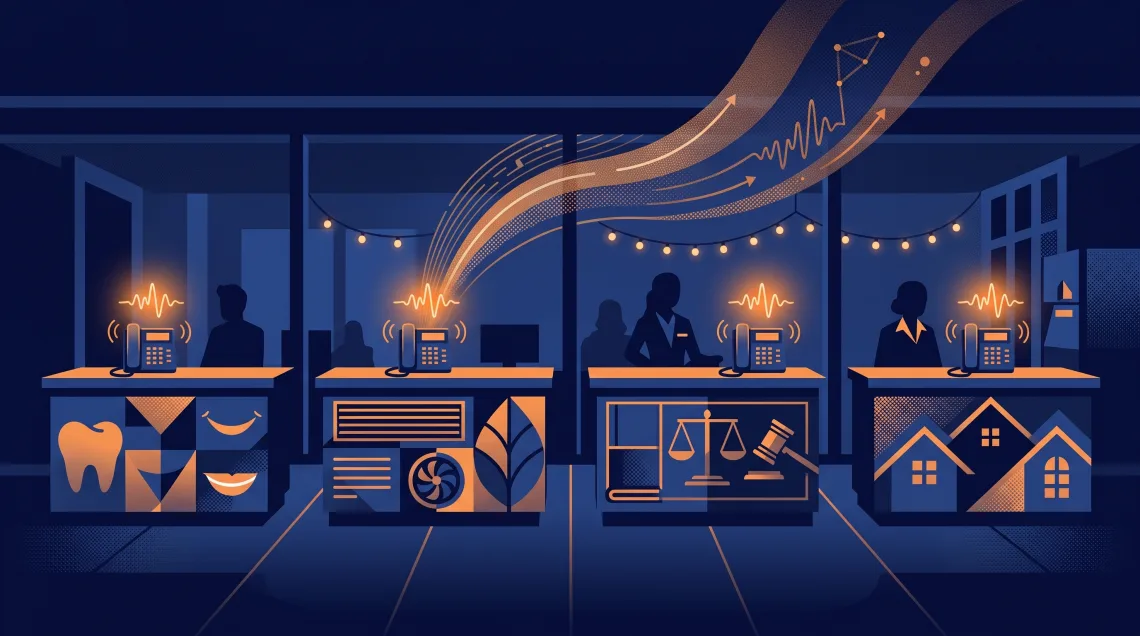
The AI vs human tradeoff varies by industry.
- Home services (HVAC, plumbing, electrical): AI wins decisively. After hours coverage is the killer use case. See AI for HVAC and AI for plumbers.
- Dental and medical: Hybrid wins. AI for routine booking, human for complex patient questions and emotional calls. See AI for dentists.
- Law firms: Hybrid wins. AI handles intake screening, human handles attorney conversations. See AI for law firms.
- Real estate: AI wins for lead callbacks. Human wins for ongoing client relationships. See AI for real estate agents.
- Auto dealerships: AI wins for service department booking. Human for sales conversations. See AI for car dealerships.
- Insurance and mortgage: AI wins for speed to lead callbacks. Human for closing complex policies. See AI for insurance agents.
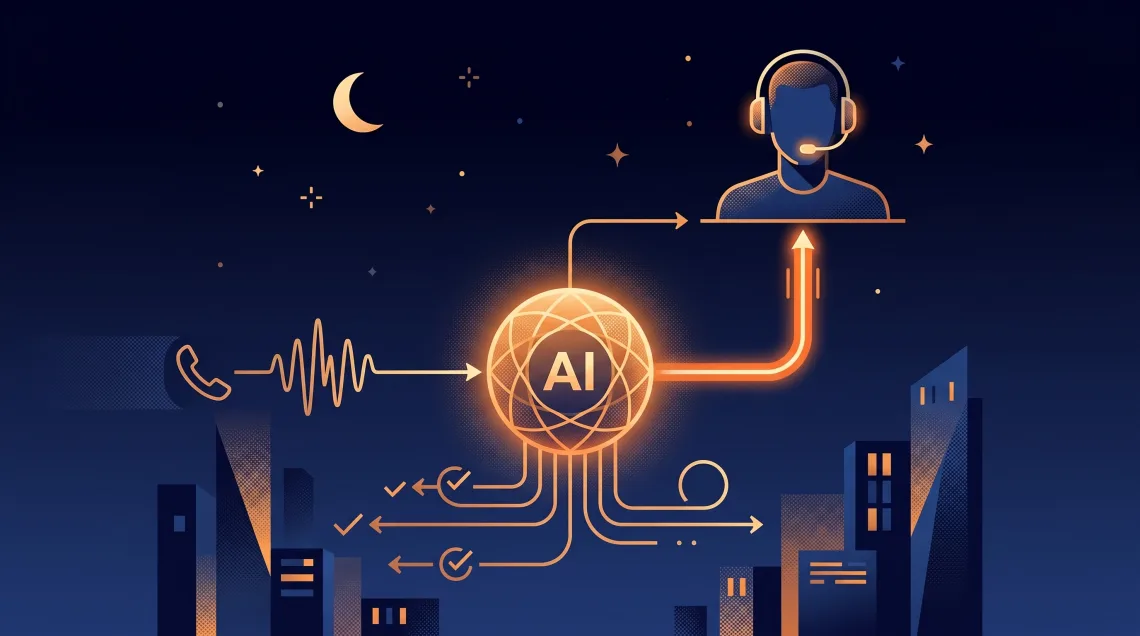
The hybrid model. AI handles 80% of calls. Humans handle the 20% that need real judgment.
Frequently asked questions
Will AI voice agents replace human receptionists?
Mostly yes for the routine 80% of calls. No for the complex 20%. Most businesses end up with a hybrid model.
Can callers tell they are talking to AI?
In 2026, 73% cannot reliably tell on calls under 3 minutes. The remaining 27% often guess wrong. Voice quality has crossed the threshold.
What about HIPAA and privacy?
AI voice agents can be HIPAA compliant with the right platform configuration and a signed BAA. Same compliance burden as a human receptionist who handles PHI.
Do I have to fire my receptionist to use AI?
No. The hybrid model keeps your receptionist and frees them up for higher value work.
How fast can I deploy an AI voice agent?
24 to 48 hours with a managed agency like CallSetter AI. 1 to 4 weeks if you build it yourself. See how to build an AI voice agent.
What if the AI makes a mistake?
Same as any system. Configure escalation rules and human review. Most AI mistakes are fixable by tuning the prompt.
Is there a callback option if the AI cannot help?
Yes. Every modern voice agent supports human handoff via warm transfer or callback request.
How does the AI handle accents and dialects?
2026 voice agents handle US English, UK English, Australian English, Indian English, and most non native English accents reliably. Spanish, French, German, Italian, Portuguese, and Mandarin work natively.
Related reading
- AI voice agent pillar guide
- Best AI voice agents 2026
- AI voice agent pricing
- AI voice agent platforms
- Retell AI review
- Synthflow AI review
- How to build an AI voice agent
- AI voice agent agency
- AI receptionist buyer’s guide
- AI answering service vs human
- 24/7 AI receptionist
- AI appointment setter
Want the hybrid model deployed for your business? CallSetter AI builds AI voice agents that work alongside your existing front desk. Live in 48 hours.
Reviewed April 2026 by Victor Smushkevich, CEO of Tested Media. Featured in Forbes, HuffPost, and MarketWatch.
Related Reading