TL;DR. A digital marketing agency in 2026 costs anywhere from $1,500 to $50,000 per month and the gap between the bottom and top is wider than ever. The reason is AI. Agencies that built their stack around AI in 2024 and 2025 are now charging the same rates as old school agencies but doing 4 to 8 times more work. This guide tells you what to actually buy, what to skip, and how to spot the AI-first agencies that get real results. If you want to talk to one, CallSetter AI that builds AI voice agents, automations, and content engines for service businesses.
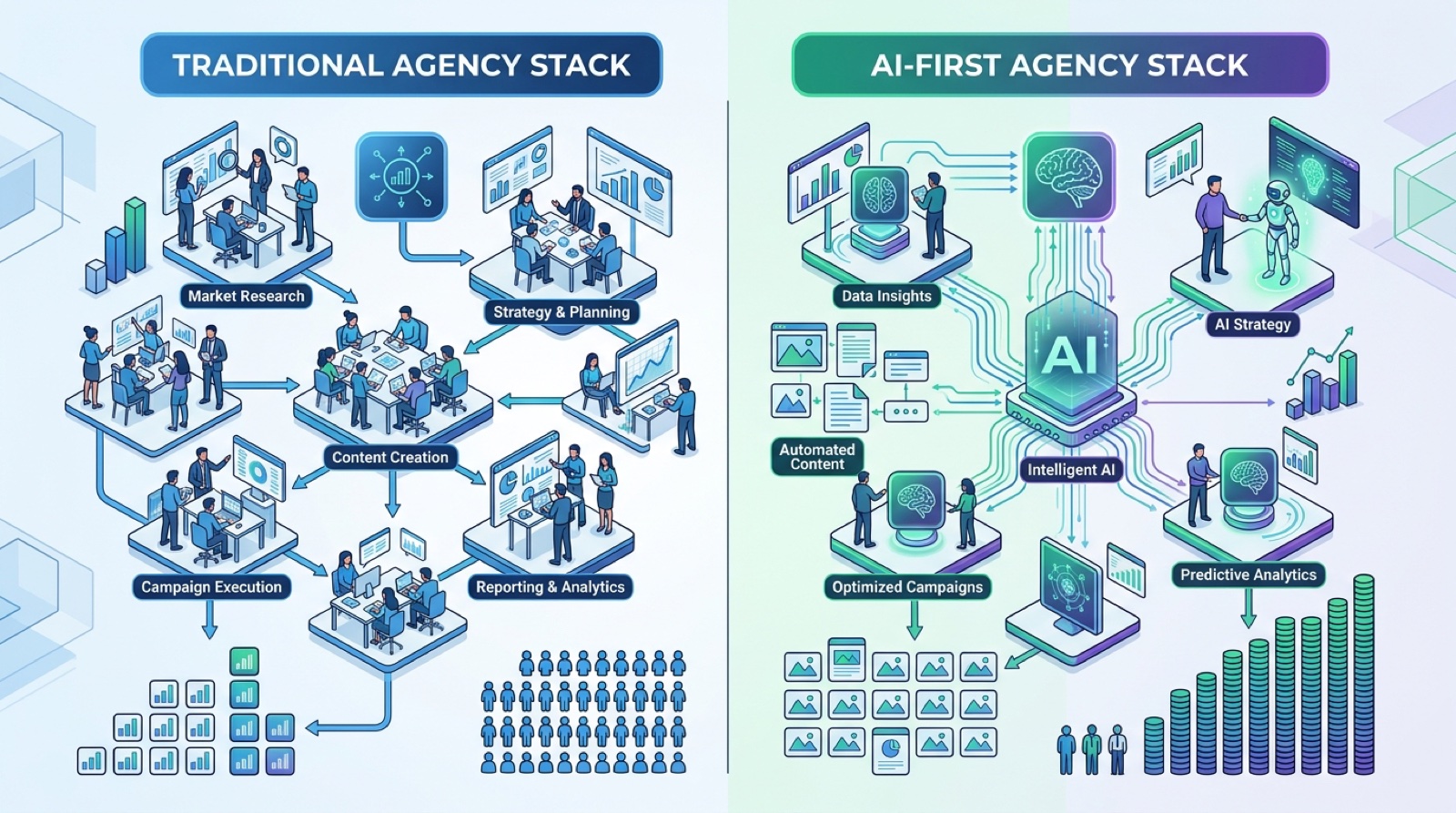
The 2026 digital marketing agency runs on AI. Campaign performance, content production, lead routing, and reporting all flow through automated systems that compress weeks of work into hours.
The textbook answer is that a digital marketing agency runs your online marketing so you do not have to. The real answer in 2026 is more specific. A modern agency does some combination of these things, and the mix matters.
SEO and content production. Writing, optimizing, and publishing content that ranks on Google and inside AI search engines like ChatGPT, Perplexity, and Gemini. This is the biggest category and the one most disrupted by AI. A good 2026 agency publishes 4 to 10 times more content than a 2023 agency at the same price.
Paid media management. Running Google Ads, Meta Ads, LinkedIn Ads, TikTok Ads, and emerging platforms. The 2026 difference is that the agency uses AI for ad copy generation, audience targeting, creative testing, and budget allocation. Manual A/B testing is dead.
Marketing automation. Setting up email flows, SMS sequences, lead scoring, CRM hygiene, and the workflows that turn a website visitor into a customer. AI now writes the sequences and decides who gets which message at what time.
Social media management. Creating and scheduling content across platforms, replying to comments and DMs, running paid promotion. Most of the content creation is now AI-assisted.
Web design and development. Building or rebuilding the website, landing pages, and conversion funnels. AI handles a huge chunk of the front end work and copywriting.
Reporting and analytics. Telling you what worked, what did not, and what to do next. The 2026 version uses AI to generate insights from data instead of dropping a 40 page PDF on your desk.
AI-specific services (the new category). Building AI voice agents, AI receptionists, AI customer service bots, AI sales SDRs, and the integrations that connect them to the rest of your business. This category did not exist in 2023. By 2026 it represents a meaningful share of agency revenue.
The agencies winning in 2026 are the ones that bundle these services and run them through a connected system instead of selling each one as a separate line item.
Pricing is wildly inconsistent. Here is what we see in real client deals across the industry, gathered from 200+ proposals and engagements over the past 18 months.
| Tier | Monthly cost | What you get | Best for |
|---|---|---|---|
| Freelancer or solo consultant | $500 to $3,000 | One service, one person, limited scope | Local businesses with one specific need |
| Boutique agency (3 to 15 people) | $3,000 to $12,000 | 2 to 4 services, dedicated team, monthly reporting | Small to mid market businesses |
| Mid-market agency (15 to 75 people) | $8,000 to $30,000 | Full service, named team, weekly reporting, custom strategy | Growing companies with $5M to $100M revenue |
| Enterprise agency (75+ people) | $25,000 to $200,000+ | Everything, plus brand strategy, PR, creative production | Mid-market and enterprise |
| AI-first specialty agency | $3,000 to $20,000 | AI-augmented services that match enterprise output at boutique pricing | Service businesses, ecommerce, SaaS |
The interesting tier is the last one. AI-first agencies operate at boutique-agency prices but deliver mid-market or enterprise output volumes because their internal stack runs on AI. We pioneered this model at Tested Media starting in 2024 and the results are why we are still here while plenty of traditional agencies have shut down.
A real example. One of our home services clients was paying $14,000 per month to a 35 person traditional agency for SEO, content, paid media, and reporting. We replaced that engagement with $4,800 per month, delivered 3x more content per month, reduced cost per lead by 41%, and added an AI voice agent that captured 32% more inbound calls. The client cancelled the old agency in week 4.
The traditional agency was not bad. They were just doing 2023 work at 2026 prices.
See exactly what services Tested Media offers.
If an agency is missing two or more of these, they are behind the curve and you should look elsewhere.
SEO is no longer just keyword research and on-page optimization. In 2026 it includes ranking inside AI search engines, creating content that answers buyer questions in detail, and producing at a velocity that was impossible in 2023. The 2026 version uses tools like Surfer SEO, Frase, Clearscope, and custom GPT workflows to scale content production from 4 articles per month to 40.
The agencies that still talk about “SEO best practices” without mentioning AI are going to lose. Our complete AI SEO playbook walks through the exact stack we use for clients.
Google Ads and Meta Ads now have AI baked into the platform. A good agency uses Performance Max, Demand Gen, and Advantage+ campaigns correctly, plus their own AI layer for creative generation and audience research. The skill is no longer “writing ads” but “designing the inputs the AI optimizes against.”
The CRM and email side of the business. HubSpot, Klaviyo, ActiveCampaign, Customer.io, and Iterable all have AI features that most agencies are not using. Setup takes a week with the right playbook and pays back within 60 days. Our marketing automation guide covers the exact workflows.
This is the new category. Most marketing efforts drive leads, but most service businesses lose 30 to 50% of inbound calls because they happen outside business hours or while staff is busy. An AI voice agent answers every call, qualifies the lead, and books the appointment automatically. This single service often delivers more ROI than every other marketing line item combined.
Tested Media specializes in this category. Most traditional agencies have not even started.
The chatbot category got wiped out by AI agents that actually work. Tools like Intercom Fin, Decagon, and Sierra AI deflect 40 to 70% of support tickets without human involvement. Our AI customer service playbook covers the buying decision.
Building or rebuilding the site is still part of the job. The 2026 difference is that AI helps with copy, layout, A/B testing, and personalization. Sites get rebuilt faster and convert better.
The deliverable changed. A 2023 agency sent a monthly PDF report. A 2026 agency gives you a live dashboard, AI-generated insights, and a strategy update every two weeks based on what the data is showing. The reports are shorter and more actionable.
If you want all 7 in one engagement, Tested Media bundles them together and runs them through a connected stack so they actually work together.
Every agency in 2026 claims to use AI. Most do not. Here is how to tell.
Real signal: they show you their AI stack. An AI-first agency can name the specific tools they use for content production, ad creative, campaign management, lead scoring, and reporting. If the answer is “we use ChatGPT for some stuff,” they are not AI-first. They are an old agency with a ChatGPT login.
Real signal: their content velocity is 4x normal. Traditional agencies publish 2 to 6 articles per month for a client. AI-first agencies publish 20 to 60. The quality has to be there too. Velocity without quality is just spam.
Real signal: they offer AI-specific services. AI voice agents, AI receptionists, AI customer service, AI SDRs. If the agency does not offer any of these, they are not actually AI-first. They are SEO-first or paid-first with AI sprinkled on top.
Real signal: their pricing is lower for the same output. An AI-first agency that uses tools to do more work in less time should charge less per deliverable, not more. If the agency charges premium prices and brags about AI, they are using AI to widen their margins, not to give you more value.
Real signal: they have AI case studies. Real numbers from real clients showing the AI work delivered measurable outcomes. Vague “we use AI to enhance our workflows” copy is meaningless.
Tested Media checks all five boxes. We started rebuilding our entire stack around AI in 2024 because we could see where the industry was going. The result is that we now deliver more work for less money than the agencies we replaced.
A short read on the major players you will encounter when shopping. We are not ranking them. Each one has a different sweet spot.
WebFX is huge, has every service under the sun, and works well for mid-market clients with budgets above $5,000 per month. They are not particularly AI-forward and pricing skews higher than the boutique competition.
Disruptive Advertising is paid media focused, very strong on Google and Meta, works best for ecommerce and lead gen with budgets above $10,000 per month.
Thrive Internet Marketing Agency offers SEO, paid, and web with broad geographic reach. Mid-market focused.
Single Grain is content and SEO heavy, founder-led, good for thought leadership and B2B brand building.
NP Digital (Neil Patel’s agency) is enterprise-focused and expensive. Strong on SEO data and reporting but the cost is in the $25,000+ range monthly.
Smart Sites is full service with strong design chops, mid-market focused, traditional in approach.
SmartSites, KlientBoost, LYFE Marketing, Ignite Visibility, Power Digital Marketing are all in the boutique-to-mid-market range with various specializations.
Tested Media is the AI-first option for service businesses. We focus specifically on bundling AI voice agents and automation with the traditional marketing services so the marketing actually converts. Pricing starts at $3,000 per month for the AI voice agent + content engine bundle.
The right agency depends on what you actually need. If you need a Fortune 500 ad campaign, hire an enterprise agency. If you need a service business marketing engine that uses AI to deliver more work for less money, hire us.
We have seen hundreds of clients come to us after firing a previous agency. The bad agencies all share the same warning signs. Here is the 5 minute test.
Ask: “What is the very first thing you would do for my business in week 1?” A good agency answers with specific tactical actions like “audit your GA4 setup, pull your last 90 days of GSC data, identify your top 5 striking-distance keywords, and write a content brief by Friday.” A bad agency answers with vague strategy speak like “we would conduct a comprehensive discovery process to align on goals.”
Ask: “Show me 3 client dashboards or reports.” A good agency has live dashboards they can screen share or export. A bad agency has PDF templates that look like marketing brochures.
Ask: “What AI tools are in your stack right now?” A good agency rattles off 8 to 15 specific tools by name and explains what each one does. A bad agency says “we use AI to enhance our workflows.”
Ask: “Who owns the work? You or me?” A good agency says you own everything. The accounts, the data, the content, the playbooks. A bad agency holds your assets hostage.
Ask: “How do you measure success?” A good agency talks about specific KPIs tied to your business outcomes (qualified leads, customer acquisition cost, lifetime value, attributed revenue). A bad agency talks about vanity metrics (impressions, reach, engagement).
Ask: “What is your average client tenure?” A good agency has clients who have been with them for 2+ years. A bad agency churns through clients every 6 months.
Ask: “Can I talk to 3 current clients?” A good agency says yes within 24 hours. A bad agency stalls or offers carefully selected references.
If they fail two or more of these tests, walk away. The cost of hiring the wrong agency is months of wasted budget and a website that ends up worse than where it started.

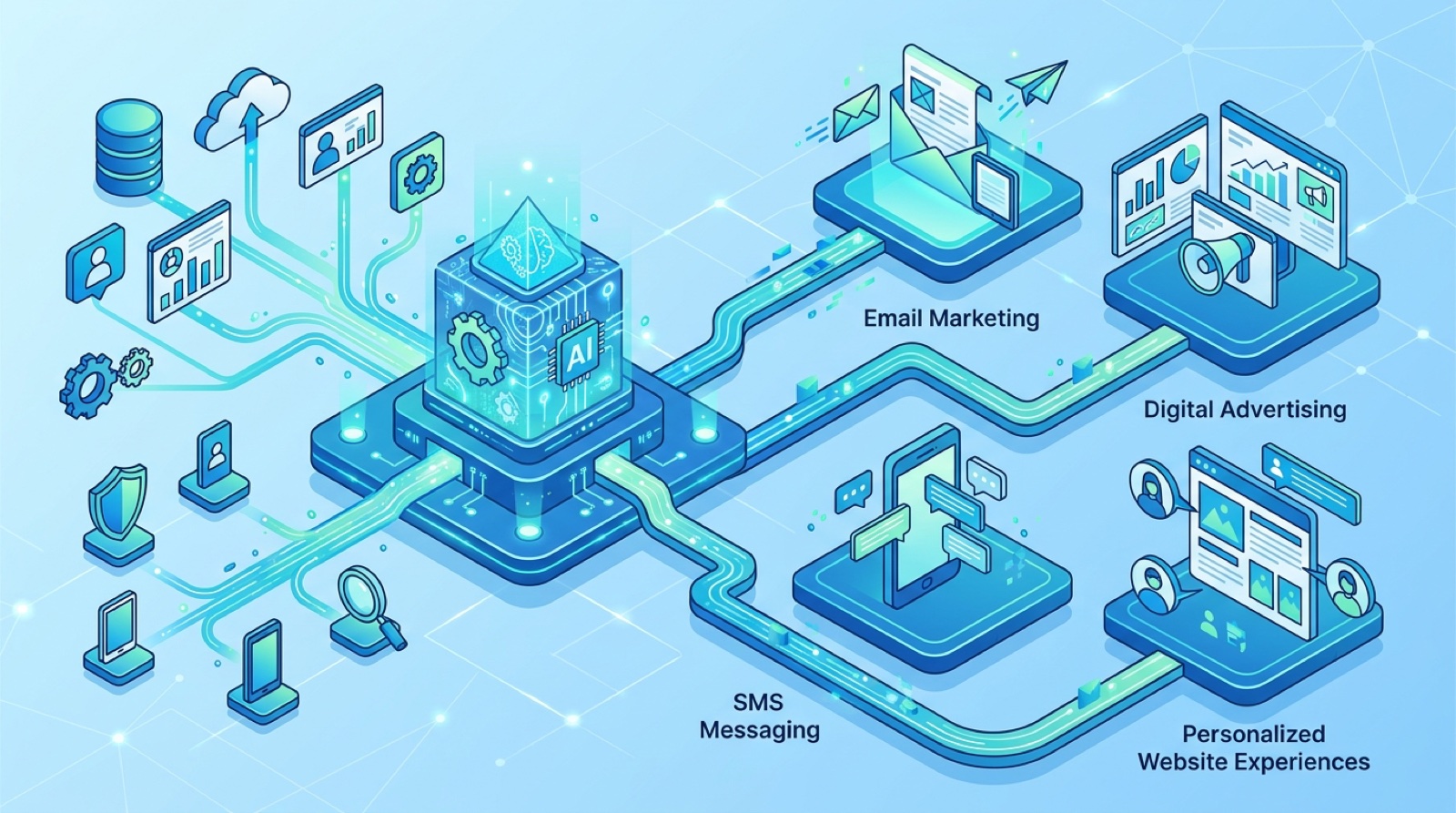
The 2026 AI-first agency stack: content, ads, automation, voice, customer service, and analytics all run through connected AI tools that compress weeks of traditional work into hours.
The phrase “AI marketing agency” gets thrown around a lot. Two definitions exist and they are almost opposites.
Definition 1: An agency that USES AI to do marketing. This is the meaningful definition. The agency’s internal workflow is built around AI tools that compress the work. They produce more content, run more experiments, and report more frequently than a traditional agency at the same price. This is what we mean when we describe Tested Media as an AI marketing agency.
Definition 2: An agency that markets AI products. This is the less interesting definition. These agencies specialize in helping AI startups with their go-to-market motion. They do not necessarily use AI in their own workflow.
When you are shopping, make sure you know which one you are talking to. They are not interchangeable.
The phrase “AI automation agency” usually refers to a slightly different business. AI automation agencies build custom workflows that automate specific tasks for a client, often using tools like Make.com, n8n, Zapier, and Airtable, plus LLM API calls.
The line between an AI marketing agency and an AI automation agency is blurry. We do both because they are usually solving the same underlying problem: a service business that has more demand than it can handle and needs technology to scale operations.
If you only need workflow automation, hire a pure AI automation agency. If you need the full marketing stack plus the automation, hire an AI marketing agency that does both. We are the second.

Most businesses agonize over this. Here is the math.
Hire a freelancer if: Your need is specific, limited, and short term. A logo, a single landing page, a one-time SEO audit. Freelancers are cheap and fast for narrow scopes.
Build an in-house team if: You have $300,000+ per year to spend on marketing salaries, you need full time control over messaging, and your output is high enough to keep multiple full time people busy. The minimum viable in-house team is 2 people (a generalist marketer plus a content producer). That costs $180,000 to $250,000 fully loaded.
Hire an agency if: You want production output without managing humans, you need multiple specialties (SEO + paid + automation + AI), and your monthly marketing budget is $3,000 to $30,000. This covers most service businesses.
Hybrid model if: You have one in-house marketing lead who manages an agency relationship. This is the most common setup for $5M to $50M revenue companies and usually works the best.
The wrong move is hiring an in-house team when your output does not justify it (you end up with 2 underutilized employees) or hiring a cheap freelancer for something that needs a coordinated team (you get 4 disconnected deliverables that do not work together).
Talk to us if you want to figure out which model fits. We will tell you the truth even if the answer is “you should hire in-house, not us.”
Generalist agencies advertise that they work with everyone. Specialists pick a vertical and dominate it. In 2026 the specialists are winning because they have repeatable playbooks for their industry while generalists rebuild from scratch on every account.
We focus on service businesses. Within that, we have detailed playbooks for:
Each industry has a different mix of marketing tactics that work, different lead behaviors, and different competitor sets. A generalist agency takes 6 months to learn your industry before they get good. A specialist starts good and gets better.
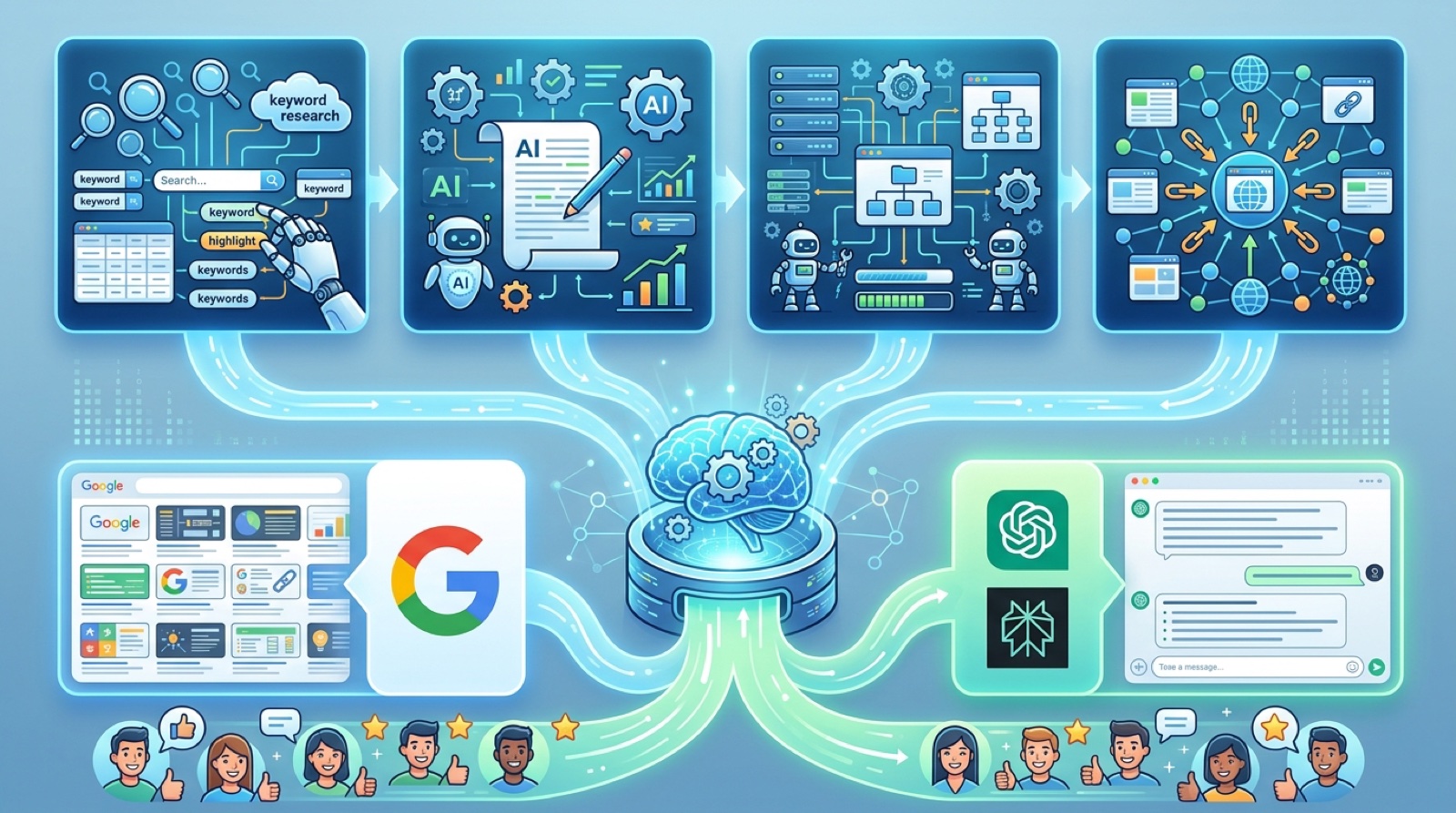
Tested Media built our 2026 AI marketing engine specifically for service businesses that need speed, output, and conversion in equal measure.
After 12 years of running marketing for service businesses, these are the patterns we see kill engagements.
1. Hiring before defining what success looks like. If you cannot tell the agency what good looks like in 90 days, you should not be hiring an agency. Spend a week getting clear on your KPIs first.
2. Buying every service in the catalog. The agency does SEO, paid, social, email, web, video, and PR? You only need 2 or 3 of those. Buying everything spreads the budget so thin that none of it works.
3. Expecting results in week 2. SEO takes 90 to 180 days to show real movement. Paid takes 30 to 60 days to optimize. Automation takes 60 days to capture full value. Voice agents work in week 1. Set expectations correctly.
4. Not giving the agency real access. The agency cannot do its job if it does not have GA4, GSC, ad accounts, CRM, email platform, and analytics access. Give them what they need or pick a different model.
5. Not measuring outcomes that matter. Impressions and traffic are vanity. Qualified leads, booked appointments, and revenue are what matters. Measure those from day one.
How much does a digital marketing agency cost per month?
Boutique agencies charge $3,000 to $12,000. Mid-market agencies charge $8,000 to $30,000. Enterprise agencies charge $25,000+. AI-first specialty agencies (like Tested Media) deliver mid-market output at $3,000 to $15,000 because their stack is more efficient.
How long does it take to see results from a digital marketing agency?
Voice agents and paid media work in weeks 1 to 4. Marketing automation takes 30 to 60 days. SEO takes 90 to 180 days. Brand and PR take 6 to 12 months. The agency should set these expectations in the first conversation.
Can a digital marketing agency really do everything in-house better than I can?
Yes if you are choosing between an experienced agency and a part time effort by a non specialist on your own team. No if you are choosing between an agency and a dedicated in-house specialist. The right answer depends on your scale.
What is the difference between a digital marketing agency and an AI marketing agency?
A digital marketing agency does the standard mix of services. An AI marketing agency does the same services but uses AI internally to do them faster and cheaper, plus offers AI-specific services like voice agents and automation that traditional agencies do not have.
Should I hire a generalist agency or a specialist?
Specialist if your industry is in a category they know. Generalist if your business is too unusual for any specialist to have a relevant playbook.
What is the difference between digital marketing agency and digital marketing services?
“Services” usually means buying one piece (SEO only, ads only). “Agency” usually means buying a coordinated bundle. Services are cheaper but less effective because the parts do not connect. Agencies cost more but the parts work together.
How do I know if an agency is using AI well?
Ask them to name the specific AI tools in their stack and explain what each one does. If they cannot, they are not actually AI-first.
Do I need a contract or can I go month to month?
Insist on month to month or a 90 day initial commitment maximum. Long contracts are how bad agencies trap clients. Good agencies do not need them because clients stay voluntarily.
Can a small business afford a digital marketing agency?
Yes. Boutique and AI-first agencies start at $1,500 to $3,000 per month, which is less than the cost of a part time employee. The right scope at this budget level is one or two services done well, not the full kitchen sink.
What is the highest ROI service a digital marketing agency offers in 2026?
For most service businesses, it is an AI voice agent that captures inbound calls 24/7. The math beats every other marketing line item. We are biased because we built this category, but the data is real.
Browse all 19 guides, reviews, and playbooks in the Digital Marketing Agency category. New articles added weekly.
A digital marketing agency runs paid ads, SEO, content, email, social, and conversion optimization for clients. In 2026, the best agencies pair these channels with AI workflows that cut cost-per-lead by 30 to 60 percent.
Most US digital marketing agencies charge $2,500 to $25,000 per month depending on scope. Boutique agencies start at $1,500 to $3,000 monthly retainers. Enterprise programs run $25k to $100k+ per month.
Hire an agency if you need specialty skills and want to launch in under 30 days. Build in-house when you have $30k+ per month to spend and can recruit specialists. Most service businesses under $5M ARR get better ROI from an agency.
Paid media drives leads in 1 to 7 days. SEO takes 90 to 180 days for meaningful traffic. Content marketing peaks at 6 to 12 months. Voice AI delivers same-day ROI by capturing leads you were already losing.
An AI-first agency builds the marketing stack on top of AI tools like GPT-5.4, Claude, voice agents, and automation platforms. The best ones can deploy a full marketing engine for a service business in 48 hours.
Talk with one of our SEO specialists today and see how we can supercharge your marketing campaigns!