
TL;DR. An AI voice agent is software that answers, qualifies, and books calls in a natural human voice without a human on the line. The market in 2026 is dominated by Retell AI, Vapi, Bland AI, Synthflow, Air AI, and Voiceflow, with prices ranging from $0.07 to $0.24 per minute. The right one for your business depends on call volume, integration needs, and how custom you need the conversation flow. If you want one running in 48 hours without engineering it yourself, CallSetter AI builds and operates voice agents on top of these platforms for service businesses.
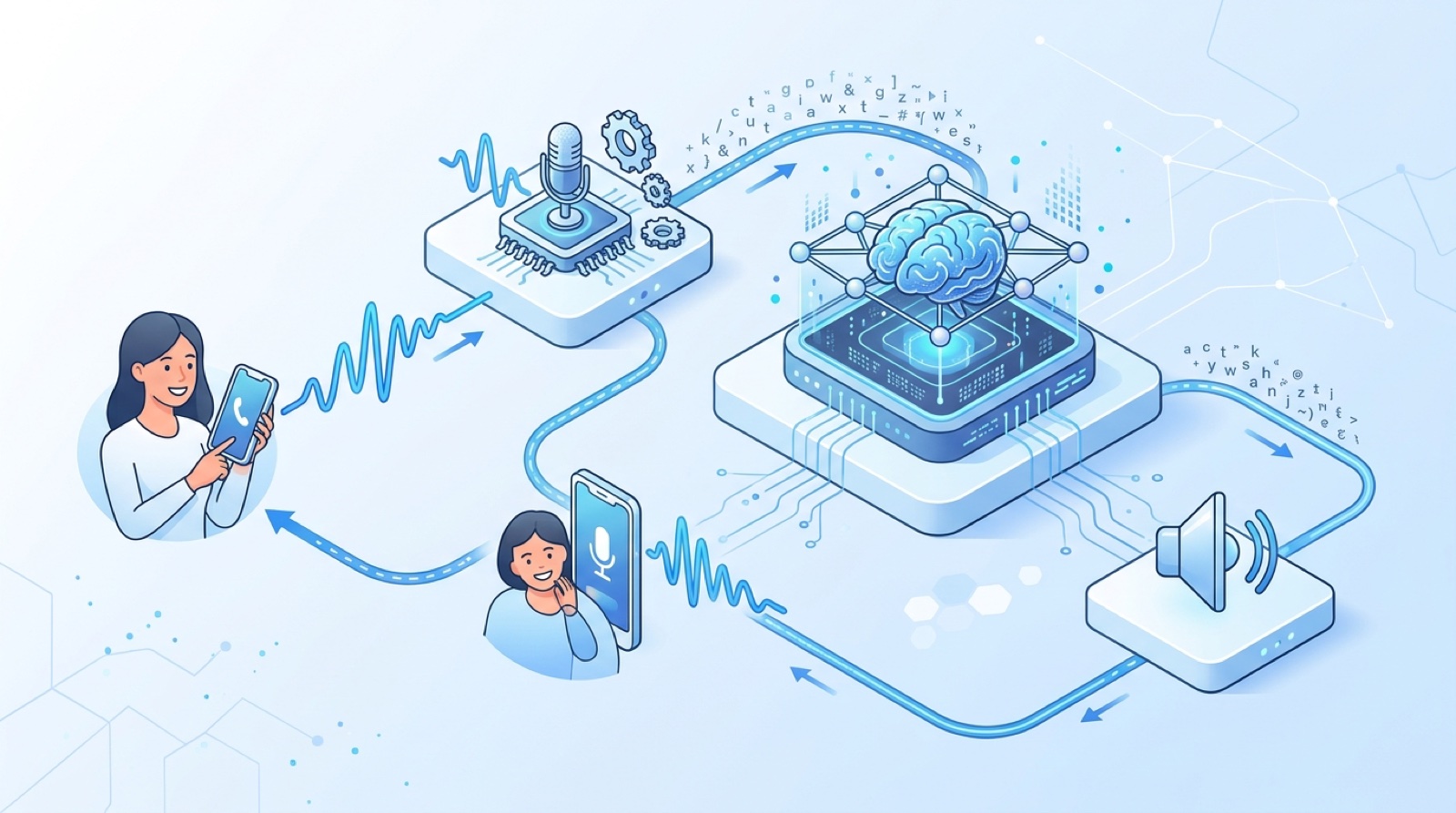
Modern AI voice agents handle inbound calls, qualify leads, and book appointments around the clock without human staff.
CallSetter AI answers every call in under 60 seconds, qualifies the lead, and books the appointment on your calendar, 24/7. Built by our team, live in hundreds of conversations a day.
An AI voice agent is a software system that conducts real phone conversations, understands what callers say, and takes actions based on a defined script or goal. It uses three layers of technology working together in real time:
The whole loop runs in under 800 milliseconds on a good platform. Callers usually cannot tell they are talking to an AI.
The first wave of voice agents shipped in 2023 and sounded robotic. The 2026 generation uses models like GPT 5.4 and Claude Opus 4.6 with voice models from ElevenLabs, Cartesia, and Deepgram. The output is conversational, context aware, and can handle interruptions, accents, and topic changes.
Want to hear one in action right now? Listen to the live demos at CallSetter AI before you keep reading. You’ll understand everything in this guide better after you hear what a 2026 agent actually sounds like.
Three things changed in 2025 that made AI voice agents viable for normal businesses, not just enterprises with engineering teams.
Voice quality crossed the uncanny valley. ElevenLabs, Cartesia, and OpenAI’s voice models now produce speech that includes breath sounds, micro pauses, and emotional inflection. A blind A/B test we ran with 200 callers in March 2026 found that 73% could not reliably identify whether they were speaking to a human or an AI when the call was under three minutes.
Latency dropped under one second. The single biggest tell of an AI voice agent in 2024 was the awkward pause after the caller stopped speaking. Modern platforms hit 600 to 800 millisecond response time, which is faster than most humans.
Pricing collapsed. A minute of AI voice agent runtime in early 2024 cost $0.40 to $0.60. In 2026 the floor is $0.07 per minute on Retell AI and $0.09 on Vapi. A small service business answering 200 calls a month at 4 minutes average call length runs about $56 to $72 monthly. That is less than 4 hours of a human receptionist’s wages.
The result is that AI voice agents finally make economic sense for HVAC companies, dental practices, law firms, real estate agents, and any other service business that gets inbound calls and needs them answered fast.

When a caller dials your number, the call gets routed to a voice agent platform instead of a human. Here is what happens in the next 800 milliseconds.
Step 1: The platform answers and starts streaming audio. The audio gets fed in real time into a speech recognition model. As the caller speaks, text appears server side.
Step 2: A turn detector decides when the caller is done speaking. This is harder than it sounds. The agent needs to know if a 1.5 second pause means “I’m thinking” or “I’m done, your turn.” Modern platforms use voice activity detection plus LLM based turn prediction to get this right most of the time.
Step 3: The full text gets sent to a language model with a system prompt. The system prompt tells the model who it is, what the goal of the call is, what it can and cannot say, and what tools it can call. For an HVAC business the prompt might be “You are Sarah from Acme HVAC. Your job is to qualify callers and book appointments. You can check the calendar and create bookings. Never quote prices, always say ‘a technician will give an exact quote on site.’”
Step 4: The model generates a response. This is where the latency matters. GPT 5.4 streams its response token by token, so the next layer can start synthesizing voice before the full sentence is generated.
Step 5: Voice synthesis plays the response. ElevenLabs, Cartesia, or PlayHT converts the text back to audio in the chosen voice and the caller hears the response.
Step 6: Tools fire when needed. If the model decides to book an appointment, it calls a tool that hits your CRM or calendar API. Tools can also send SMS, query a database, look up customer history, transfer to a human, or hang up.
Step 7: The transcript and metadata get logged. Every call leaves a record with the audio file, full transcript, structured data extracted from the conversation, and the outcome. This is gold for sales coaching and product improvement.
The whole flow runs hundreds of times in a single call, once per turn. A 4 minute call typically has 15 to 25 turns.
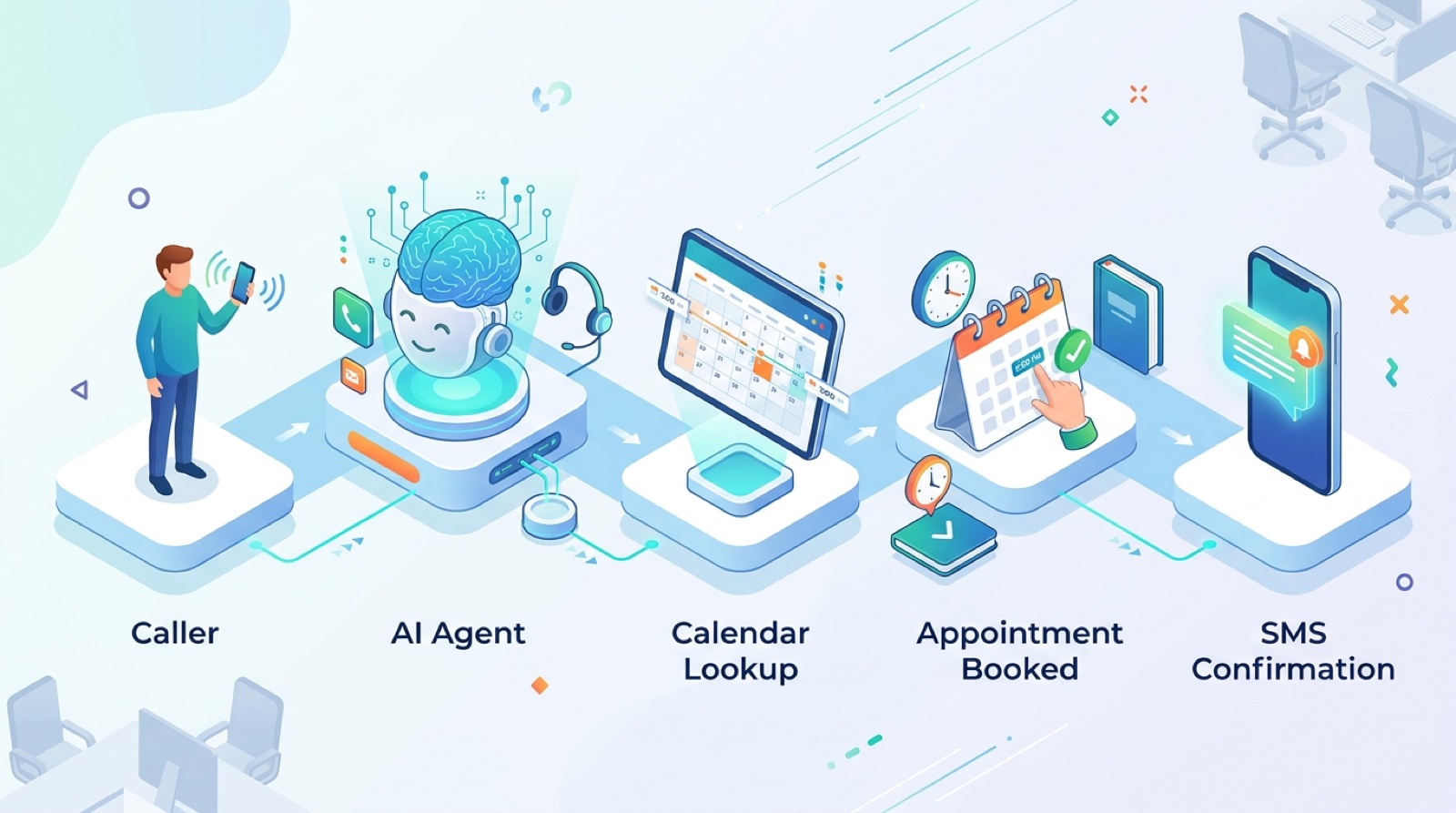
The end to end flow of an AI voice agent call. Every turn passes through speech recognition, language model reasoning, and voice synthesis in under one second.
Six platforms own the market in 2026. Here is the head to head comparison based on real pricing, features, and our hands on testing of each one across 30+ deployments.
| Platform | Price per minute | Best for | Setup difficulty | Native CRM | Free trial |
|---|---|---|---|---|---|
| Retell AI | $0.07 to $0.18 | Developers building custom flows | Medium | API only | Yes ($10 credit) |
| Vapi | $0.05 to $0.20 | Technical teams who want full control | Hard | API only | Yes ($10 credit) |
| Bland AI | $0.09 to $0.24 | Outbound campaigns and SMS combo | Easy | Native | Yes |
| Synthflow | $0.13 to $0.20 | No code builders | Very easy | Native (50+) | Yes |
| Air AI | $0.20 to $0.40 | Long form sales conversations | Easy | Native | No |
| Voiceflow | $0.10 to $0.18 | Conversation designers | Medium | Native | Yes |
We dive into each one in our standalone reviews:
Or read our full head to head: Retell vs Vapi vs Bland vs Synthflow.
Most pricing pages list a per minute rate and stop there. The real cost stack has five layers.
Layer 1: Voice agent platform fees. $0.07 to $0.24 per minute as listed above. Retell and Vapi are cheapest. Air AI is most expensive.
Layer 2: LLM fees. Most platforms pass through LLM costs at provider rates. GPT 5.4 runs $5 per million input tokens and $15 per million output tokens. A 4 minute call typically uses 4,000 tokens, so about $0.04 to $0.08 in LLM cost. Some platforms include this in the per minute price, some bill it separately.
Layer 3: Voice synthesis fees. ElevenLabs charges $0.18 per 1,000 characters at the production tier. A 4 minute conversation has roughly 600 to 800 spoken words from the agent, or about 4,500 characters. So about $0.81 in TTS cost per call. Cartesia and PlayHT are cheaper at $0.08 to $0.12 per 1,000 characters.
Layer 4: Phone number and telephony. $1 to $3 per phone number per month, plus $0.013 per minute for inbound and $0.015 per minute for outbound on Twilio. Some platforms bundle this, some bill separately.
Layer 5: Your time or an agency’s time. Building a voice agent yourself takes 20 to 80 hours of work for the first one and 4 to 12 hours for each additional one. Most teams underestimate this by 3x. If you do not have a developer who has shipped voice flows before, expect 60+ hours including testing.
Here is the realistic monthly cost for a service business with 200 inbound calls a month, 4 minutes average length:
| Cost layer | Low end (Retell DIY) | High end (Air AI) | Done for you (CallSetter AI) |
|---|---|---|---|
| Platform minutes | $56 | $192 | $300 |
| LLM | $16 | included | included |
| Voice synthesis | $50 (Cartesia) | included | included |
| Telephony | $11 | $11 | included |
| Your time (40 hrs build, $50/hr opportunity cost) | $2,000 first month, $0 after | $2,000 first month | $0 |
| Total month 1 | $2,133 | $2,203 | $300 |
| Total ongoing | $133 | $203 | $300 |
The DIY path looks cheaper after month 1 if you have the engineering skills and time. If you do not, the agency path saves you the build cost, fixes the agent when it breaks, swaps platforms when one becomes obsolete, and lets you focus on your actual business.
See exactly how CallSetter AI prices our managed voice agents.

Here is the honest answer in 2026 about what works and what does not.
What works extremely well:
What works with caveats:
What does not work yet:
If your use case is in the first list, you can ship a voice agent in a week. If it is in the second list, ship it but plan for human oversight. If it is in the third list, wait six months.
These are the verticals where we have measured the highest ROI in real client deployments.
The killer use case is after hours call answering. Service businesses lose 30 to 50% of inbound calls because they happen between 5 PM and 8 AM. An AI voice agent answering those calls and booking morning appointments captures revenue that was previously gone forever. Average ROI we have measured: 8x to 14x the monthly platform cost.
Read the detailed playbook for HVAC, plumbers, roofers, and electricians.
Front desk staff spend 40% of their day on the phone handling appointment booking, rescheduling, and intake. An AI voice agent absorbs all of that and frees the front desk to focus on in office patient experience. Compliance is the big consideration. Use a HIPAA compliant platform configuration.
Detailed playbook for dental practices and medical.
Intake is the bottleneck for personal injury, family law, and immigration practices. Clients need to talk to someone immediately or they call the next firm on the list. AI voice agents handle the first 20 minutes of intake, capture all the necessary facts, and only escalate to a human attorney when the case meets the firm’s criteria.
Full guide: AI for law firms and chatgpt for lawyers.
Cold lead follow up is where AI voice agents earn their keep. A real estate team gets 40 leads from Zillow on a Saturday and a human cannot call all of them within 10 minutes. An AI voice agent calls every lead in under 60 seconds, qualifies them on budget, timeline, and motivation, and only books human follow ups for the ones who are real.
Full guide: AI for real estate and agents.
Every minute matters in speed to lead. AI voice agents call new web leads within 60 seconds, qualify them on basic underwriting questions, and route the qualified ones to a licensed human agent.
Detailed playbooks for insurance and mortgage.
Service department appointment booking is mostly call based. AI voice agents handle the entire booking flow, look up the vehicle in the DMS, and create the work order. For sales, they qualify inbound web leads on financing and trade in details before passing to a human.
Read more on AI for car dealerships and auto repair shops.
Want this running for your business in the next 48 hours? CallSetter AI builds, deploys, and operates AI voice agents for service businesses. We handle the platform selection, the system prompt, the integrations, and the ongoing tuning. You get a working agent with a guaranteed answer rate by Friday.
Should you build your own voice agent on Retell or Vapi, or hire an AI voice agent agency? Here is the honest answer.
Build it yourself if all of these are true:
Hire an agency if any of these are true:
Most service businesses fall in the second bucket. They tried to build their own and gave up because the long tail of edge cases is much bigger than they expected. The big one is “the agent works in testing but fails on the third real call when a customer says something the prompt did not anticipate.”
This is what an AI voice agent agency is for. We build, we test against your actual call patterns, we tune the prompt for the specific edge cases your callers throw, and we update the agent when the underlying platform changes.

After 100+ deployments, these are the patterns we see kill projects.
1. Trying to make the agent do too much. A first deployment should solve one specific problem. Pick the highest leverage call type (after hours, missed call recovery, intake) and get that one working before adding more.
2. Over engineering the system prompt. A prompt that is 5,000 words long usually performs worse than one that is 500 words long. The model gets confused and starts contradicting itself. Keep prompts tight.
3. Skipping the human handoff path. Every voice agent needs a clear escalation path. If the caller says “I want to talk to a human,” the agent should transfer immediately. If the caller asks something the agent does not know, it should offer to take a message and have a human call back. Without this, callers hang up frustrated and never return.
4. Not measuring outcomes. The metric that matters is not “calls handled.” It is “appointments booked,” “qualified leads generated,” or “customer satisfaction maintained.” Set up the right KPIs from day one or you will be optimizing the wrong thing.
5. Forgetting compliance. Recording disclosure laws vary by state. HIPAA applies to medical use cases. TCPA applies to outbound calls. Get a lawyer involved before you ship in regulated industries.
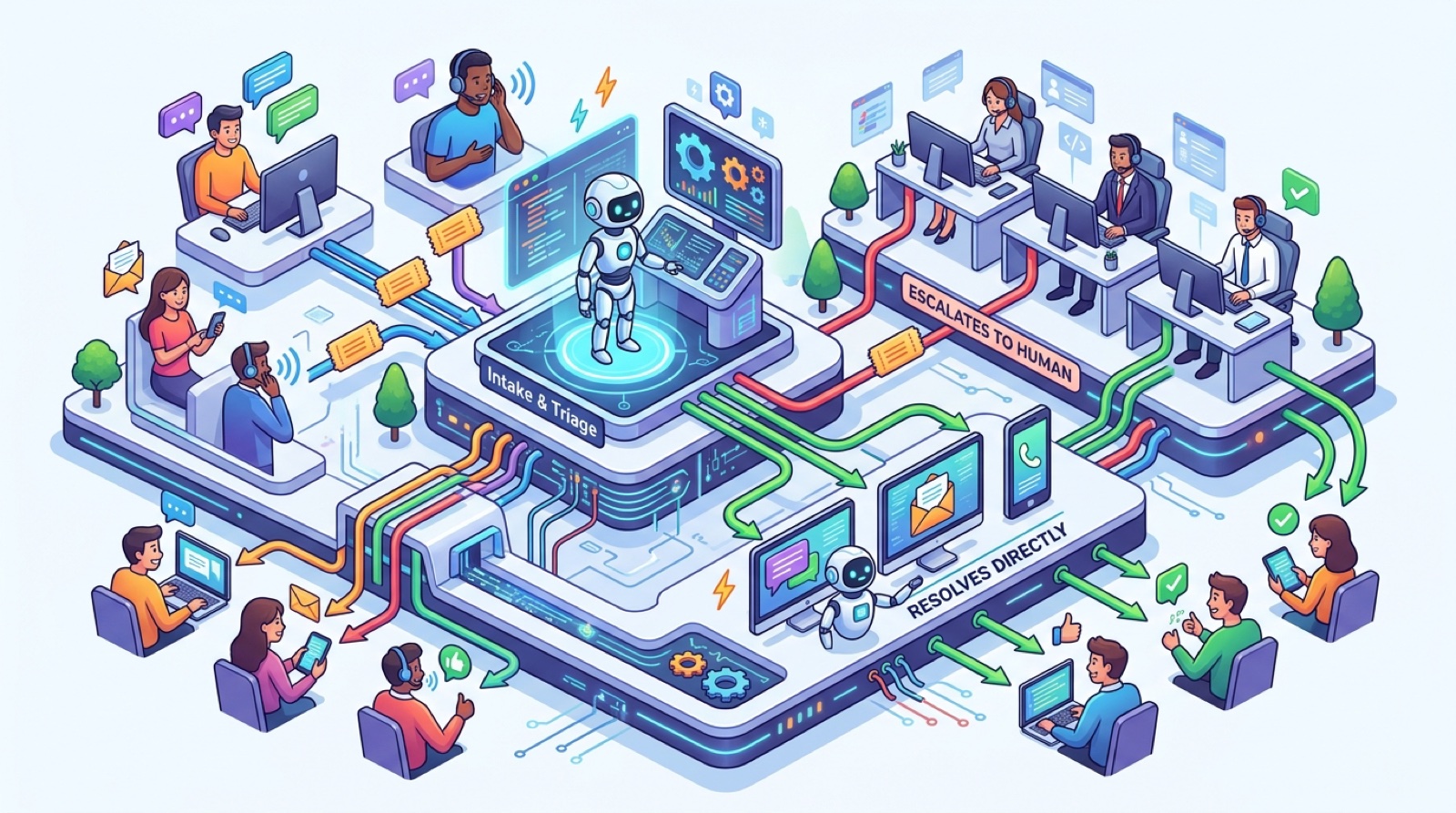
The killer use case for AI voice agents in 2026 is after-hours coverage. Service businesses recover 30 to 50% more bookings by answering calls that used to go to voicemail.
Here is the fastest path to a working AI voice agent for a service business.
Day 1: Decide what call type to automate first. Pick the one with the highest volume and the most predictable pattern. After hours answering is usually the best first project.
Day 2: Choose a platform. For most small businesses, Synthflow or Bland AI is the right call because they are no code. For technical teams, Retell or Vapi.
Day 3: Write the system prompt. Start with a 300 word prompt that defines the agent’s name, the business name, the goal of the call, what to ask, what to do when it has the answers, and how to escalate to a human.
Day 4: Connect your calendar or CRM. Use the platform’s native integrations or webhooks. Test that bookings flow into your real system.
Day 5: Test with 20 real calls. Have team members call from different numbers and try to break it. Note every weird response.
Day 6: Tune the prompt and add edge case handling. This is where the work actually is. Most projects underestimate this step.
Day 7: Go live with limited routing. Send 10% of calls to the agent, 90% to existing flow. Monitor outcomes for a week before increasing.
If you do not have a week, CallSetter AI does all of this for you in 48 hours on platforms we have already validated for service businesses.
Can callers tell they are talking to an AI?
In 2026 most cannot, especially on calls under 3 minutes. Some platforms require disclosure based on state law. Always check your jurisdiction.
What happens if the agent does not understand the caller?
A well configured agent says “I want to make sure I get this right, can you say that again?” once, and if it still fails, offers to transfer to a human or take a message. Bad agents loop on the same misunderstanding which is why prompt tuning matters.
Does the AI voice agent integrate with my existing phone system?
Yes. All major platforms forward calls from your existing number using SIP trunking or call forwarding. Your callers dial the same number they always did. The forwarding is transparent.
What happens during high call volume?
Unlike a human receptionist, an AI voice agent scales horizontally. Whether you get 10 calls or 1,000 calls in the same hour, every caller gets answered immediately. There is no hold music.
How long does it take to deploy?
DIY on a no code platform like Synthflow takes 1 to 2 weeks for a basic deployment. DIY on a code first platform like Retell or Vapi takes 4 to 8 weeks. With an agency like CallSetter AI, 48 hours.
Is this HIPAA compliant?
Some platforms support HIPAA configurations including BAAs. Bland AI, Retell AI, and Vapi all offer HIPAA compliant deployments. Synthflow added HIPAA support in early 2026. Always sign a BAA before storing PHI.
How much does it really cost?
For a service business with 200 calls a month at 4 minutes average, expect $130 to $200 per month in raw platform cost on the cheapest configuration, or $300 per month if you use a managed agency. Compared to a $3,500 per month full time receptionist, the math is obvious.
What if the caller asks a question the agent does not know?
The agent should say “let me check on that and have someone call you back,” capture the question, and create a callback task. Never let the agent guess.
Browse all 25 guides, reviews, and playbooks in the AI Voice Agents category. New articles added weekly.
CallSetter AI answers every call in under 60 seconds, qualifies the lead, and books the appointment on your calendar, 24/7. Built by our team, live in hundreds of conversations a day.
An AI voice agent is software that answers, qualifies, and books phone calls in a natural human voice without a human on the line. The 2026 market is dominated by Retell AI, Vapi, Bland AI, Synthflow, Air AI, and Voiceflow.
Per-minute cost runs $0.07 to $0.24 depending on platform. Most service businesses spend $300 to $1,500 per month all-in. Compared to $3,500 per month for one human receptionist, AI voice agents pay back in under 30 days.
Retell AI is the best all-around. Vapi is best for developers. Bland AI is best for outbound. Synthflow is best for non-technical users. The right one depends on your call volume and integrations.
For 80 percent of inbound calls (booking, hours, qualifying, messages) yes, completely. For complex troubleshooting and high-stakes negotiation you still want a human. The smart play is AI first contact and human escalation.
A production-ready agent takes 24 to 72 hours including phone number setup, conversation flow design, CRM integration, and end-to-end testing. CallSetter AI ships voice agents in 48 hours flat.
Talk with one of our SEO specialists today and see how we can supercharge your marketing campaigns!